 By
By Salesforce and Anthropic announced Claudeforce on August 26 — a partnership that makes Claude the default reasoning engine across the entire Salesforce stack. If you build on Salesforce, integrate with it, or just field the quarterly “AI roadmap” emails from your CRM team, this changes things. The open beta drops in September. Here is what actually matters.
This Is Three Products, Not One
The name Claudeforce covers three distinct workstreams, and conflating them will waste your time:
- Claude in Salesforce: Claude now powers the Atlas Reasoning Engine, Agentforce Vibes IDE, Agentforce Coworker, and Agent Builder. This one is live. No beta, no waitlist.
- Salesforce in Claude: A plugin that gives Claude 37 prebuilt sales skills — meeting prep, deal health review, pipeline management. One admin connects the org; all users get access scoped to their existing permissions. Open beta expected September 2026.
- Claude in Slack: Claude is now the default model across Slackbot, Claude Tag, and Slack Code. Salesforce says internal adoption is at 83%.
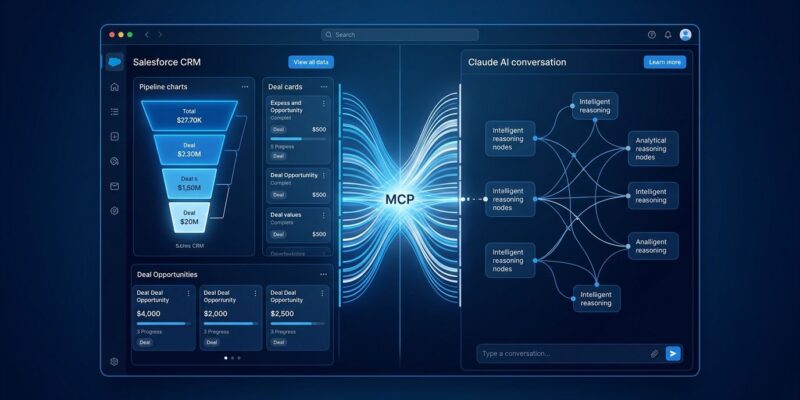
The most architecturally interesting piece is the second one. “Salesforce in Claude” flips the access model: Claude becomes the interface, Salesforce becomes the data layer underneath. Marc Benioff called it “a dynamic interface.” That is one way to describe what happens when your CRM becomes an API that an AI calls. Read the official Claudeforce announcement if you want the full partnership scope.
The MCP Architecture Behind It
Headless 360, Salesforce’s platform initiative from April 2026, is the technical foundation. It exposes the entire Salesforce platform via MCP, API, and CLI. The hosted MCP server (in Beta since July 2026, requires API v67.0+) is deliberately minimal — four meta-tools instead of hundreds of endpoints:
| Tool | Function |
|---|---|
| Discover | Semantic search across all available Salesforce operations |
| Describe | Returns the technical specification for a given operation |
| Dispatch | Invokes any operation: GET, POST, PUT, DELETE, PATCH |
| Dispatch (Read-Only) | GET-only variant for read-restricted contexts |
The search-describe-call pattern is worth your attention as a design pattern. Instead of flooding an agent’s context window with 200 API definitions, the agent discovers what it needs on demand. The Salesforce Headless 360 developer guide covers the full architecture. Winter ’27 (v68.0) hits production in waves: September 4, October 2, and October 9.
What the Marketing Leaves Out
Here is where most Claudeforce coverage stops asking questions. These are the things you need to know before planning a Q4 rollout:
Writes trigger your existing automation. When an AI agent calls dispatch to update a record, Salesforce runs validation rules, Flows, Apex triggers, and CPU-time governors exactly as it would for a human. Your carefully tuned automation fires. Plan for it.
Token pricing is separate and variable. Claudeforce uses consumption-based pricing tied to API calls, and organizations contract with Anthropic directly for inference. Based on current developer patterns with agentic sessions, bills run $200 to $2,000 per developer per month. Instrument a pilot cohort before signing anything org-wide.
Shadow IT is a live risk. The official plugin requires admin setup, but any developer can stand up an unauthorized MCP connection alongside it. Without token attribution by team, you won’t see the spend until it is already a problem.
Both the MCP server and the plugin are still in Beta. Not suited for critical production workflows in Q4. Stagger your sandbox testing with the Winter ’27 upgrade waves — you want to know which change broke what.
The Bigger Signal
Yahoo Finance called Claudeforce “the end of model-agnostic enterprise AI.” The framing is worth taking seriously. This aligns the world’s largest CRM with a single AI provider at the infrastructure layer. OpenAI and Google now compete in a landscape where Salesforce’s core agentic workflows default to Claude by design, not by configuration.
Salesforce is betting that owning enterprise data and business rules stays valuable even when employees access it through a competitor’s AI interface. That bet costs roughly $300 million in Anthropic token spend in 2026 alone. Whether it pays off depends on whether Claude-in-Salesforce generates enough workflow efficiency to justify the shift from seat-based to consumption-based spending — a question 81% of enterprise executives are already stressed about when it comes to AI vendor dependency.
How to Start Before Open Beta
If you are evaluating Claudeforce now, this is the sequence that makes sense:
- Start with read-only Permission Sets using
dispatch_readonly. Observe agent behavior before granting write access. - Run a pilot cohort. Get your actual token numbers before committing to org-wide contracts.
- Stagger sandbox testing with Winter ’27 upgrade waves. September 4 is the first production wave.
- Audit your existing MCP connections. If teams are already running unofficial integrations, surface them now.
The technical breakdown from Apex Hours covers the authentication models and permission scopes in detail if you’re ready to go deeper on the MCP server setup. Claudeforce is a real shift in how Salesforce data gets accessed by AI — the architecture is sound, the gotchas are solvable, but only if you see them coming.