 By ByteBot
AWS announced this morning that it has signed a definitive agreement to acquire DuckLabs, the Amsterdam-based company behind DuckDB — the embedded analytical database now downloaded more than 3 million times per day. The deal closes in early September 2026. The developer community’s immediate reaction was predictable and warranted: they’ve watched this exact movie before with Redis, Elasticsearch, and HashiCorp, and it rarely ends well for open source independence. The question is whether DuckDB’s legal structure makes this time genuinely different.
What the DuckDB AWS Acquisition Actually Means
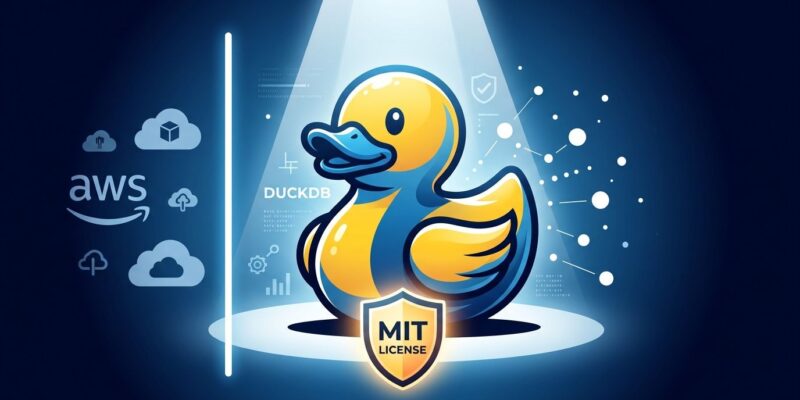
The distinction matters: AWS is acquiring DuckLabs, the company, not the DuckDB open source project. The DuckDB Foundation — an independent non-profit established before this deal — holds intellectual property for DuckDB, DuckLake, and Quack. All three remain under the MIT license. That last part is critical. MIT is irrevocable. No acquirer can reverse permissions already granted to the public.
Founders Mark Raasveldt and Hannes Mühleisen were direct: “There are no changes for our projects’ roadmap, licensing, and governance model.” AWS VP Andy Warfield confirmed DuckDB will stay “completely open source and easily embeddable in so many types of applications.” The team stays in Amsterdam. Development continues at the same pace. According to the official DuckDB blog announcement, DuckLabs joins AWS as a new subsidiary while the Foundation retains independent control of the projects.
Why the Community Is Nervous Anyway
Pattern recognition is not paranoia. In 2021, Elastic changed Elasticsearch’s license to SSPL and AWS forked it as OpenSearch. In 2023, HashiCorp moved Terraform to BSL, IBM acquired them for $6.4B, and OpenTofu reached 10 million downloads as a community fork. In 2024, Redis relicensed from BSD-3, and AWS itself had to back the Valkey fork under the Linux Foundation — which now has 150+ contributors from 50+ organizations. Each time, the company in question reassured the community before making the change.
As AWS’s own Valkey blog post makes clear, the Redis relicensing required extraordinary steps to keep the project open. The uncomfortable truth is that AWS has been on both sides of this: the company that accelerated open source adoption, and the company whose market power pushed smaller projects to lock down their licenses. Developers watching the DuckDB acquisition are not being unreasonable. They are being informed by recent history.
Related: Hugging Face $13B Sale: What Happens to Open-Source AI
Why DuckDB’s Open Source Position Is Structurally Stronger
The Foundation model is a different legal architecture than anything Redis, Elastic, or HashiCorp had in place. Those companies owned their IP outright — so when the business model changed, the license could change with it. DuckDB’s Foundation holds the IP independently. MIT-licensed contributions cannot be revoked because the license grants users perpetual rights that survive any company transfer. There is no dual-license lever, no SSPL trick, no BSL workaround. The legal separation is real.
Additionally, DuckLabs never raised venture capital. It funded itself through commercial support contracts, which actually removed the VC exit pressure that historically drove other open source projects toward relicensing. As The Register noted, the lack of external investor exit pressure is a meaningful structural difference from the standard VC-backed acquisition story. The acquisition removes the commercial contract dependency without replacing it with investor pressure.
The Real Thing to Watch: Advisory Board Governance
Legal protections are necessary but not sufficient. The part worth monitoring is the upcoming Technical Advisory Board — a new body AWS plans to add to the DuckDB Foundation, where commercial stakeholders influence the roadmap. The composition and voting rights of this board are not yet defined. AWS will be the employer of 100% of DuckDB’s core developers. Even without controlling the IP, an AWS-dominated advisory board could shape the project’s direction without touching the license. According to the official AWS announcement, plans for the advisory board are still taking shape.
Watch the board composition announcement carefully. Who holds seats? What do voting rights look like? Does AWS have a veto on roadmap priorities? Those answers will tell you more about DuckDB’s practical independence than any promise made today. The license is protected. The governance is still being written.
Key Takeaways
- AWS acquired DuckLabs (the company), not DuckDB (the open source project) — the DuckDB Foundation retains independent IP control under MIT license
- MIT licensing is irrevocable: no acquirer can reverse permissions already granted, making this structurally safer than the Redis, Elastic, or HashiCorp situations
- The open source skepticism is earned — the industry’s track record of acquisition-followed-by-relicensing is consistent and recent
- The real test is the Technical Advisory Board: watch its composition and voting structure when announced
- For developers today: nothing urgent — your existing DuckDB code runs on MIT-licensed software that cannot be taken away