 By ByteBot
Omarchy 4 (Quattro) shipped August 14 and does something no Linux distribution has done before: it treats AI coding agents as operating system citizens. Not apps you happen to run alongside your work — citizens. The status bar tracks your Claude Code weekly burn rate. When a process segfaults, the OS asks if you want to route the core dump to your agent. A new Rust-based multiplexer called Herdr knows whether each of your agents is idle, working, blocked, or done. DHH’s Arch-based distro is the first Linux desktop built around the assumption that you’re running multiple AI agents all day, every day.
One Process Instead of Eight
The most visible change in Quattro is the complete rewrite of the desktop shell using Quickshell. Previously, Omarchy stitched together eight separate tools: Waybar for the bar, Walker as launcher, Mako for notifications, SwayOSD for on-screen displays, hyprlock and hypridle for locking, swaybg for wallpaper, and polkit-gnome for authentication prompts. In Quattro, all of that lives in one long-running QML process. The practical result is that changing your theme updates the bar, terminal, notifications, btop, Neovim, and VS Code simultaneously. Memory footprint for the entire desktop sits under 300 MB. The bar now supports drag-and-drop repositioning and converts to a vertical sidebar when docked to the left or right edge. Consolidating eight independent processes into one coherent shell eliminates an entire category of “my notifications look different from my bar” annoyances that plagued the previous version.
The OS Knows You Have Agents Running
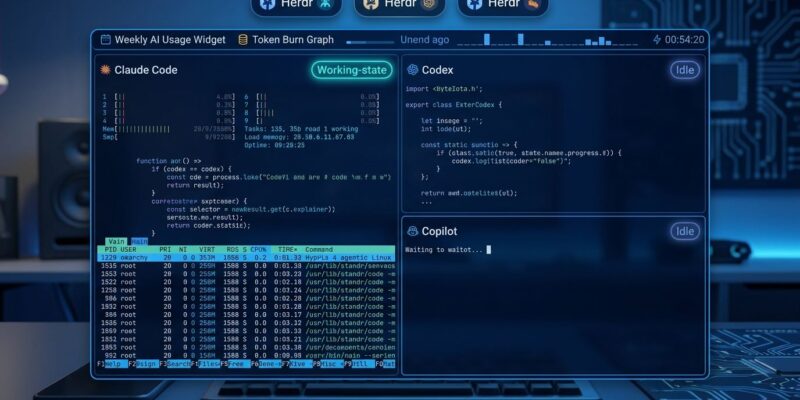
The agent integration is where Quattro makes its real argument. A status bar widget tracks your Claude Code or Codex plan limits, weekly burn percentage, and token consumption — without opening a browser or checking a dashboard. Nine agents are pre-wired and accessible via Super + Shift + Ctrl + A: Claude Code, OpenAI Codex, OpenCode, GitHub Copilot, Gemini, Grok, Pi, Crush, and Oh My Pi. Agents launch in your ~/Work directory for proper trust handling.
The crash routing is the most interesting piece. When a process segfaults, Omarchy offers to hand the core dump directly to your default agent for analysis — the kind of thing that sounds small until you’ve spent forty minutes staring at a stack trace at 11 PM. An “Omarchy skill” also teaches agents how to reconfigure the machine itself within defined boundaries. All of this is off by default. You have to explicitly set a default agent in Setup > Defaults. This was the right call: the loudest criticism of Quattro before launch was that DHH was forcing AI on everyone. The opt-in design defuses that objection without gutting the feature.
Herdr Is the Part Most Coverage Is Missing
Herdr is a Rust-based terminal multiplexer that ships in Omarchy’s base package set. It had roughly 29,000 GitHub stars before Omarchy bundled it. The distinction from tmux is specific: tmux doesn’t know what’s running inside a pane. Herdr does. Agent state — idle, working, blocked, done — is a first-class property surfaced per pane. Agents in different panes can control each other, meaning Claude Code can oversee a Codex session running adjacent. Herdr also handles git worktree management so multiple agents work the same repository without conflicts, and sessions persist on headless servers so you can check on a running agent from your phone over SSH. If you’re running more than one coding agent simultaneously, Herdr solves problems that tmux wasn’t designed for.
The Debate Omarchy Is Walking Into
Not everyone is following. IroncladDev, a developer who previously credited Omarchy with converting him from macOS, publicly stated he won’t upgrade to v4 — the distro now prioritizes agent features he never asked for. It’s FOSS framed it as “Omarchy Bets Its Future on AI Agents While the Linux World Stays Cautious,” which is accurate given that Rust, GCC, and Codeberg have banned AI-generated code contributions. There’s a genuine philosophical split in open source over whether AI tooling belongs at this layer. The counter-argument — all AI features off by default — addresses the loudest objection, but doesn’t settle the bigger question about what kind of distro Omarchy wants to be. The project has 31,639 GitHub stars and 569 open issues. Those two numbers live in permanent tension on a rolling-release distribution.
What It Actually Signals
Omarchy Quattro matters beyond its user count. If AI coding agents are becoming as central to developer workflow as a browser, operating systems are going to have to decide how to handle them at the OS level. Herdr’s 29,000 pre-Quattro stars are evidence that this demand exists now. Microsoft has its Agent Framework GA. Apple is embedding Claude into Xcode. Omarchy is making the argument at the desktop OS layer, and it’s the first to do it coherently. The distro isn’t for everyone — rolling Arch, Secure Boot disabled, 569 open issues, and a steep keyboard-shortcut learning curve make it impractical for most. But the pattern it’s establishing is worth watching regardless of whether you’re running it.