 By ByteBot
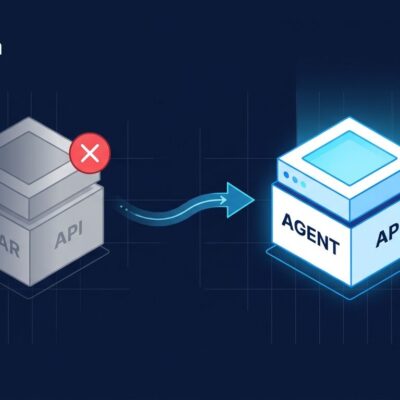
Alibaba’s MAI-UI team released Qwen-UI-Agent on August 20 — an open-weight GUI agent under Apache 2.0 that outperforms Claude Opus 4.8 on mobile benchmarks and edges it on browser tasks too. The weights are live on Hugging Face. But the more durable story is not the leaderboard: it is the architecture. This is the first widely available model designed from the ground up to treat GUI automation as a unified cross-platform problem — mobile, desktop, browser, CLI, and web research in one action space, not four separate systems duct-taped together.
Not Just Another Click Bot
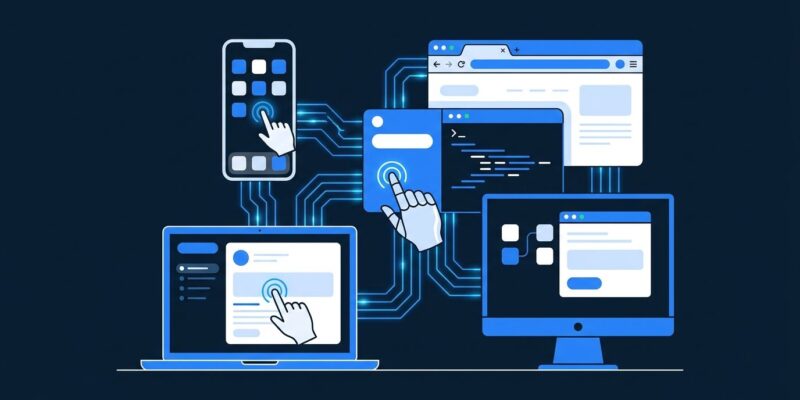
Most GUI agents are specialists: click things in a browser, swipe things on a phone, or run terminal commands. Qwen-UI-Agent merges four action modalities into one inference pipeline:
- GUI actions — click, type, drag, scroll, long press
- CLI commands — bash execution on the desktop, mid-task
- API calls — external service integration without breaking task context
- DeepSearch — structured web research (Serper + Jina) woven into execution
Over 40% of desktop task outputs are batched — the model emits multiple consecutive actions in a single inference pass rather than waiting for screen feedback after every click. That is a meaningful efficiency gain on long workflows. The real-device training setup adds credibility: 100+ physical smartphones and 150+ apps, not emulators.
Real workflows rarely stay in one interface. A task that pulls a price from a website, cross-references a map, and then adds a calendar entry requires three contexts. Qwen-UI-Agent was built to handle that handoff without routing through three separate specialized systems.
The Benchmarks — and the Honest Caveat
The numbers are strong:
- MobileWorld: 82.1% (+14.6 percentage points over Claude Opus 4.8)
- MobileWorld-Real: 92.2% (+7.5pp over Claude Opus 4.8)
- AndroidDaily: 97.5%
- WebArena: 73.6% (+1.7pp over Claude Opus 4.8)
Here is the caveat: these benchmarks test common tasks on familiar apps in their default state. The OSWorld 2.0 benchmark — which tests long-horizon tasks where the median takes a human 1.6 hours — tells a harder story. The best frontier system on that benchmark completes just 20.6% of tasks. Qwen-UI-Agent’s 40% partial-progress score on OSWorld-v2 is the current leader on efficiency (58.4% fewer steps than the next competitor), but partial credit is not shipped software.
Take the benchmark wins as signal, not guarantee. Plan for failures in production.
Four Architecture Patterns Worth Stealing
Whether or not you run MAI-UI weights, the design decisions in Qwen-UI-Agent are a useful template for any agent system that needs to touch real screens.
1. Separate grounding from workflow management. Knowing what is on screen and knowing what to do next are different problems with different failure modes. Most GUI agents mix them and fail at both. Keep them architecturally distinct.
2. Give your agent multiple action channels. GUI-only agents get stuck the moment a task requires a terminal command or an API call. Building CLI access alongside click actions expands the solution space without requiring a separate orchestration layer.
3. Track partial progress explicitly. A task that fails at step 47 of 60 is not the same as a task that fails at step 2. If your system treats every failure as total loss, you are throwing away recoverable work. Build partial completion tracking and resumption from the start.
4. Build failure memory. The Qwen-UI-Agent training harness uses step-level judges to distinguish model failures from environment failures — a crashed app is not the same as a wrong click. Your production system needs that same distinction to improve over time.
What Is Open, What Is Not
The MAI-UI-2B and MAI-UI-8B weights are on Hugging Face under Apache 2.0. The GitHub repo has the project overview and links to the technical report. What is not open: the production training harness (10,000 concurrent sandboxes and the real-device fleet), a managed inference API, and the 235B variant used for the top benchmark scores. You are self-hosting if you want to run it today.
Enterprise teams should note: Apache 2.0 weights do not solve isolation, observability, or governance. Those remain your responsibility.
Who Should Move Now
Experiment with MAI-UI-8B if you are building agents that need to interact with legacy enterprise software that has no API, or if you are replacing RPA bots on stable, well-defined screen workflows. The model’s performance on common tasks in familiar apps is genuinely strong.
If your use case involves long-horizon unpredictable tasks — open-ended research, multi-hour workflows, highly variable UI states — wait for the ecosystem to mature. The benchmark-to-production gap is real, and the absence of a managed inference API means significant self-hosting work.
The more practical short-term move for most developers: take the architecture patterns from the technical report and apply them to your current agent stack. The insights on unified action spaces, partial progress tracking, and failure taxonomy hold regardless of which model sits underneath.