 By ByteBot
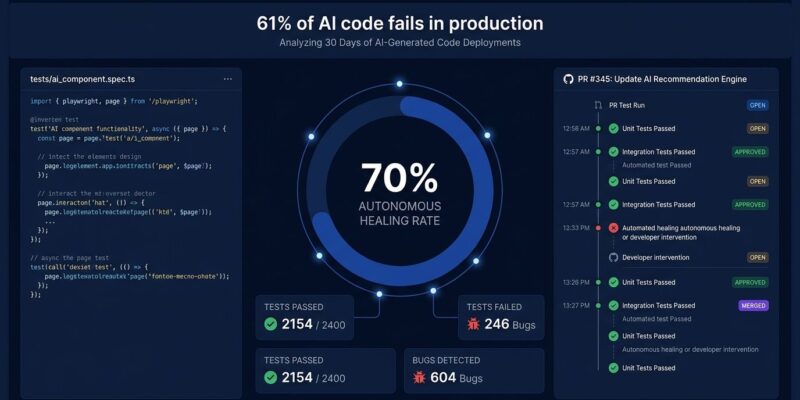
Sixty-one percent of engineering leaders shipped a production incident caused by AI-generated code in the last 90 days — and in every case, that code had already passed code review and unit tests. The testing tools weren’t the problem. The mismatch was. Code review and unit tests were designed for a world where humans write code at human speed. They were never built to verify the behavioral output of an AI agent committing fifty changes before lunch. Checksum’s Continuous Quality Loop, launched August 4, is the first QA product built specifically for that reality.
The Paradox That Started It
New Relic’s 2026 State of AI Coding Report captured the contradiction precisely: 94% of technology leaders rate AI-generated code as higher quality than human-authored code at review time. Then, once that code hits production, 78% of organizations report a measurable spike in incidents. Eighty-two percent experienced at least one production failure tied to AI code in the past six months. Senior engineers are spending more time firefighting. Technical debt is compounding faster than it’s being paid down.
The problem isn’t that AI writes bad code. It’s that AI writes plausible code — code that looks correct in isolation, passes static analysis, and satisfies the unit test surface area. What it misses are behavioral regressions: the user flow that breaks, the API edge case that only surfaces under real traffic, the UI interaction that depends on state accumulated across three other flows. You don’t catch those with unit tests. You catch them with end-to-end tests — and until now, nobody had an agent that could write and maintain those fast enough to keep up.
What the Continuous Quality Loop Does
Checksum’s approach starts from a simple premise: the test suite should be owned by an AI agent, not maintained by engineers. The Continuous Quality Loop works as a background agent, not a copilot. You don’t prompt it. It watches.
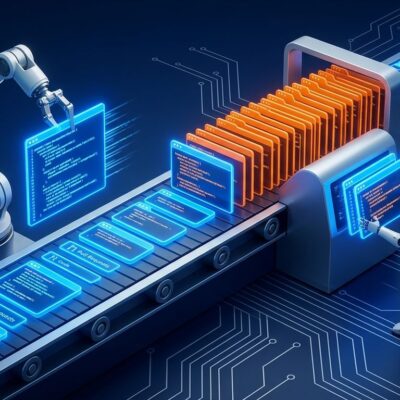
When a pull request opens, the loop triggers automatically through the GitHub integration. It analyzes what changed, generates end-to-end Playwright tests based on real user session data captured via a Chrome extension, and opens a PR with those tests. If existing tests fail, it determines whether the failure represents a real bug or a stale test reflecting a valid UI change. Seventy percent of failures resolve autonomously — the agent patches the test, opens a PR, and moves on without engineer involvement.
Critically, the tests are standard Playwright code stored in your own repository. Not a proprietary DSL, not tests locked in a vendor dashboard — actual TypeScript your engineers can read, modify, and own. The MCP server extends the loop into whatever tools your team already uses, so testing appears as part of the development workflow rather than a separate system to check.
Setup: Four Components
The stack is straightforward. The GitHub App handles the PR integration. The Chrome extension lets engineers capture sessions to seed test generation directly from the browser. The Checksum CLI runs tests locally and triggers the autonomous agent. The MCP server pulls testing into existing developer tool workflows. Pricing starts at $50/month.
What Customers Report
Counterpart, an agentic insurance platform, describes running “a 10x QA team on Checksum at less than half the cost of one offshore developer” with no production outages since deployment. Movable Ink and Lyra Health have both deployed it to keep end-to-end coverage current as their products change under AI-driven development cycles.
These aren’t the kind of results you get from a testing copilot that helps engineers write tests faster. They’re the results you get from a system that removes engineers from the test maintenance loop entirely.
The Bigger Problem This Is Solving
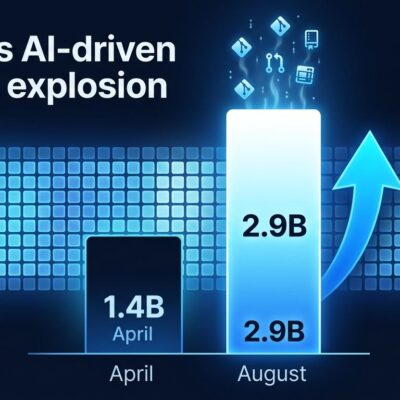
GitHub’s own data shows commit volume doubled in four months, driven by AI coding agents. More code, shipping faster, across more surfaces. Human QA doesn’t scale with that. The industry has spent years optimizing the code generation side of AI development while largely ignoring the verification side. The Continuous Quality Loop is the direct answer to that imbalance: if an AI agent is writing your code, another AI agent should be verifying it — continuously, automatically, and without waiting to be asked.
If your team is using Claude Code, Cursor, or Codex to generate code at speed and relying on code review and unit tests to catch regressions, the 61% statistic suggests you’re already overdue for a better answer. Check the VentureBeat data on AI code debugging rates — 43% of AI-generated changes need debugging in production. That’s not a testing problem. That’s a testing architecture problem.