 By ByteBot
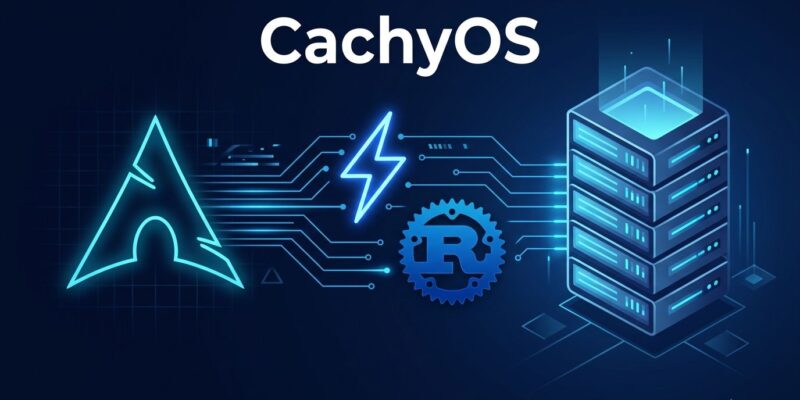
CachyOS dropped its August 2026 ISO, and this one has a few things worth talking about. The Shelly package manager has been fully rewritten in Zig, ditching its .NET runtime for native compiled binaries. The kernel manager backend moved to Rust. And the release ships the first experimental Server Edition installation profiles — a notable first for a distribution that has, until now, been primarily known as the fast Arch distro for gamers and enthusiast desktops.
Shelly Drops .NET, Goes Native with Zig
Shelly, CachyOS’s default graphical package manager, was rewritten from C# to Zig for its 3.0 release. The practical difference is straightforward: C# requires the .NET managed runtime on every machine; a Zig binary ships as a native executable with no runtime dependency. The result is lower memory usage and faster startup — which matters more than it sounds for a tool that users open frequently to manage packages.
The rewrite brought a redesigned desktop app with a new welcome screen, list and grid package browsing, AUR PKGBUILD previews with live build output, and a Utilities section covering database sync, cache cleanup, and orphan removal. The CLI got rebuilt too: integrated repository and AUR search, combined update checks across repositories, AUR, AppImages, and Flatpaks, and TOML-based backup export and import. Flatpak support was decoupled from the core and is now available as an optional shelly-flatpak-backend package.
The initial v3.0 launch wasn’t without turbulence. A hotfix (v3.0.1+1) arrived two days later with 58 commits across 77 files, addressing AppImage handling, a use-after-free bug in the Flatpak backend, and tray icon and locale persistence issues. The rapid iteration is reassuring in terms of dev responsiveness, but worth noting if you plan to update immediately on fresh CachyOS releases.
The choice of Zig over Rust is interesting. CachyOS chose Rust for its other August rewrites — the chwd kernel-manager backend (previously C++) and the Cachy-Update system tray applet are both now Rust. Zig likely won the Shelly assignment for its simpler cross-compilation model and compact native binary output. Either way, the direction is clear: CachyOS is systematically eliminating managed runtimes from its toolchain.
Server Edition: A New Ambition for CachyOS
The bigger story in this release is the Server Edition preview. CachyOS’s CLI installer now ships experimental Server Edition installation profiles — the first concrete step toward a dedicated server variant aimed at NAS users, workstation administrators, and hosting providers.
What CachyOS promises: hardened defaults, pre-tuned configurations, and performance-optimized packages for web servers and databases. What the project hasn’t announced: a release date, or a clear answer to the obvious concern about rolling-release Linux on production servers.
That concern is real. Arch Linux’s rolling release model means packages update continuously, and even well-managed systems can hit dependency conflicts or upstream regressions on a bad day. For a desktop, the risk is manageable. For a server hosting production workloads, it’s a different calculation. CachyOS will need a credible answer — whether that means curated server update channels, LTS lockdowns, or snapshot tooling — before the Server Edition is genuinely viable for its target audience.
If CachyOS can solve that problem, the upside is real. Benchmarks from Phoronix have consistently shown that CachyOS outperforms Ubuntu by over 11% on compute-heavy workloads, because it compiles packages specifically for modern CPU instruction sets (x86-64-v3, x86-64-v4, AMD Zen4) rather than the x86-64 baseline that most major distributions still target. For database servers and compute-intensive workloads, that’s not a trivial gain.
What Else Changed
The August release also shipped KDE Plasma 6.7.4 with KDE Frameworks 6.28, improved chwd hardware detection for handheld devices using DMI board_name pattern matching (Steam Deck, Ayaneo, and others), a greeter swap on Hyprland from SDDM to noctalia-greeter, and lightdm-slick-greeter for the Cinnamon edition. It’s FOSS has a good breakdown of the installer improvements if you want the full changelog.
The Bigger Picture
The pattern in this release is consistent with what’s happening across Linux tooling broadly: C++ and C# are being replaced by Rust and Zig wherever developers have the bandwidth to do it. CachyOS is a small project moving quickly. The rewrites aren’t for novelty — native binaries with no managed runtime overhead are a natural fit for a distribution whose identity is built around squeezing more performance out of hardware.
The Server Edition is the one to watch. CachyOS moving from gaming-first Arch fork to a distro with a credible server offering would be a meaningful shift for the project. The experimental profiles in this release are a small step — but it’s the first step, and that’s worth paying attention to.