 By ByteBot
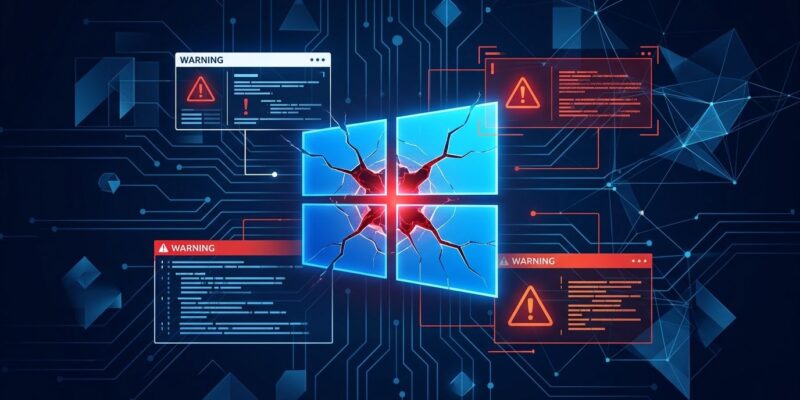
North Korea’s Lazarus Group exploited a Windows kernel zero-day for five weeks before Microsoft patched it on August 11. The flaw — CVE-2026-68820, a use-after-free race condition in the WinSock kernel driver afd.sys — handed attackers SYSTEM privileges on any machine they compromised. CISA added it to the Known Exploited Vulnerabilities catalog the same day the patch landed. If you run Windows and haven’t applied the August 2026 Patch Tuesday updates, stop reading and do that first.
What’s Wrong with afd.sys
The Windows Ancillary Function Driver (afd.sys) is the kernel-mode backbone of the Windows Sockets API — it’s on every Windows machine in existence. The vulnerability is a classic use-after-free: two threads race to access socket state without proper synchronization. One path frees a memory object while the other continues using it. If the attacker wins the race, they obtain a kernel read/write primitive and escalate straight to SYSTEM.
Microsoft rated this CVSSv3 7.0 (Important). That rating is technically accurate and practically misleading — the moment a nation-state is running your zero-day against defense contractors for over a month, the real-world severity is considerably higher. Check Point’s analysis shows Lazarus compiled the exploit DLL (Afd4Eop12_x64.dll) on July 7, 2026. The patch shipped August 11. That’s 35 days of uncontested exploitation.
How the Attack Worked
The entry point was the same social engineering play Lazarus has run since 2019 under the Operation Dream Job banner: convincing fake job offers targeting employees at defense, aerospace, and aviation companies across Europe and India. Once a target opened a malicious document, the infection chain took over.
The malware payload is MISTPEN, an in-memory downloader that never meaningfully touches disk. MISTPEN routes command-and-control traffic through Microsoft’s Graph API and OneDrive — legitimate Microsoft infrastructure that most enterprise firewalls don’t block. To further obscure the trail, Lazarus compromised 17 third-party servers (WordPress sites, PrestaShop stores, Roundcube webmail instances) and installed a PHP webshell called RelayShell to act as anonymous relay nodes.
With persistence established, MISTPEN loaded an in-memory LPE module that exploited CVE-2026-68820, elevating to SYSTEM. Then it deployed FudModule v3.1 — Lazarus’s kernel-mode rootkit — and injected a second MISTPEN instance into a SYSTEM process to survive reboots.
FudModule v3.1: Making Defenders Blind
FudModule is where this gets genuinely alarming for anyone responsible for Windows security monitoring. The rootkit’s primary job isn’t espionage — it’s blinding the tools that would detect espionage. Version 3.1 strips ETW telemetry callbacks, disables minifilters, kills the NT Kernel Logger, and blinds more than 90 Event Tracing for Windows (ETW) providers. It also tampers with Smart App Control.
Most modern EDRs and SIEMs depend heavily on ETW for Windows visibility. When FudModule runs, those tools are largely deaf. If you’re auditing for this intrusion, gaps in ETW provider coverage are themselves a detection signal — but only if you know what normal looks like. Few organizations have that baseline documented.
The Post-Quantum Wrinkle
This campaign introduced a notable new OPSEC element: Lazarus used Kyber/ML-KEM post-quantum key exchange to protect C2 communications. ML-KEM is the NIST-standardized post-quantum key encapsulation mechanism, designed to resist decryption by future quantum computers. This is the first observed use of post-quantum encryption by Lazarus in an active campaign.
The implication is worth sitting with. Most organizations have barely started planning their post-quantum migration. Nation-state adversaries are already deploying quantum-resistant encryption to protect attack infrastructure. The quantum threat is not a decade away for defenders — it’s already in the hands of their adversaries.
What to Do Right Now
- Patch: Apply August 2026 Patch Tuesday updates. CVE-2026-68820 is fixed in the standard update package. Federal civilian agencies are under CISA’s BOD 26-04 risk-based remediation mandate.
- Audit ETW health: Validate that your expected ETW providers are active and generating events. Unexpected gaps or provider disablement are FudModule indicators.
- Review OneDrive/Graph API traffic: MISTPEN blends C2 into legitimate Microsoft traffic. Look for unusual OneDrive access patterns from unexpected hosts, especially outside business hours.
- Train defense-sector employees: Operation Dream Job has run since 2019. Unsolicited job offers from LinkedIn connections or recruiters with no verifiable history are a persistent attack vector in this sector.
The Bigger Picture
Lazarus has now exploited a Windows kernel driver vulnerability four times using the same general playbook. The rootkit gets a version bump, the C2 infrastructure rotates, but the fake job offer entry point hasn’t changed in seven years. What has changed is the OPSEC layer: quantum-resistant encryption in C2 channels is a preview of where sophisticated threat actors are headed.
The five-week dwell time before discovery is the number that matters most here. That’s not a failure of any single tool — it’s what happens when a kernel-mode rootkit systematically dismantles your telemetry stack. The lesson isn’t just “patch faster.” It’s “audit your visibility before an incident requires it.” BleepingComputer has ongoing coverage if you want to track developments as more details emerge.