 By
By The Deno team released celld on August 5 — an open-source daemon that runs Cloudflare Workers and Durable Objects on infrastructure you own. The stack is V8, SQLite, LTX, and Tokio, licensed Apache-2.0. With 2,600 GitHub stars in four days and a lively Hacker News thread, this is not a weekend side project. It’s the Deno team making a deliberate bet that the Cloudflare Workers API becomes the standard interface for stateful edge compute — and that you should be able to run it anywhere.
What celld Actually Is (and Isn’t)
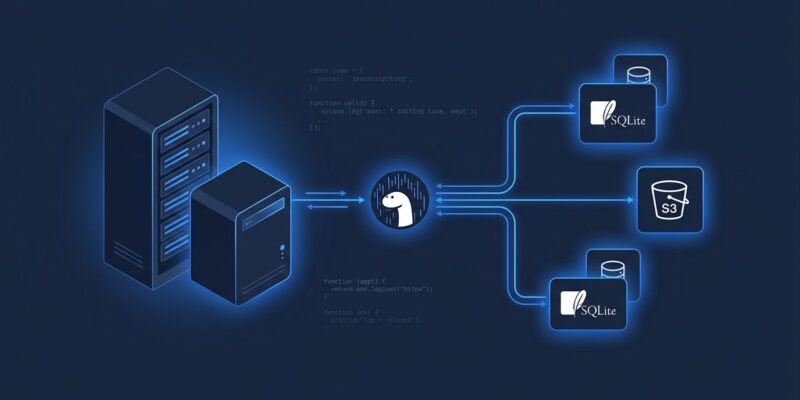
Cloudflare’s own open-source workerd already handles Worker JavaScript execution. celld is not that. celld is the coordination layer on top — the piece that gives each Durable Object its own isolated SQLite database, replicates it continuously to an S3-compatible bucket you control, and enforces single-owner semantics using S3 compare-and-swap operations. No control plane. No consensus algorithm. No membership service. The bucket coordinates everything.
The architecture is genuinely elegant: writes are durable before they are acknowledged (RPO=0), idle cells hibernate to nearly zero resource use, and when a cell migrates or wakes, its new owner restores from the bucket and resumes. Nodes are disposable because the bucket is the source of truth.
Your existing Workers code runs unchanged. Same Wrangler APIs, same wrangler.jsonc config. Deploying is two commands:
celld deploy . --bucket s3://my-cells-bucket
celld --bucket s3://my-cells-bucket --listen 0.0.0.0:8080
The Cost Math
Cloudflare enabled SQLite storage billing for Durable Objects in January 2026, making the already non-trivial cost structure harder to predict at scale. According to celld.dev, 100 resident cells on celld run you roughly $49 per month. The same workload on Cloudflare Durable Objects runs around $415 per month — an 88% reduction. That gap widens as you scale, since hibernated cells on celld cost essentially nothing beyond S3 storage, while Cloudflare charges for idle state too.
Ryan Dahl described it as “order of magnitude cheaper at scale.” Developer Justin Schroeder called it “the most important architecture project of the year” and pointed to its fit for AI agent workloads that need stateful, portable compute.
Performance
Benchmark figures from the official site: stateless requests hit approximately 0.2ms p50 latency and 94,000 requests per second per worker thread. Active cell overhead sits at about 4 MB per instance. These numbers are competitive for the use cases Durable Objects are designed for: collaborative tools, real-time state, per-user storage, and AI agent memory layers.
The Trade-offs Are Real
Before you start migrating, be honest about what you are giving up. Cloudflare operates 330+ points of presence — celld gives you however many machines you run. If you need sub-10ms latency from Tokyo and Frankfurt simultaneously, you need your own global infrastructure or you stay on Cloudflare.
Peer-to-peer communication in celld does not include TLS. The docs recommend private networks or WireGuard overlays — reasonable, but operational work you now own. The project also requires esbuild on PATH for Worker projects and an S3-compatible bucket (AWS, MinIO, Backblaze B2, or similar).
The broader point: running a distributed stateful system is not the same as using Cloudflare’s dashboard. celld removes vendor lock-in and dramatically cuts cost. In exchange, you carry the operational burden. That trade is right for some teams and wrong for others.
Who Should Use celld
The case is strongest for organizations in regulated industries — finance, healthcare, government — where EU AI Act data residency requirements (in force since August 4) make Cloudflare-hosted state a compliance problem. If your Durable Objects data needs to stay in a specific jurisdiction, celld running against a regional S3 bucket is a clean answer.
The second case is cost at scale. If you’re running hundreds of cells and looking at four-figure Cloudflare bills, 88% savings is a real budget argument. The third is AI infrastructure: teams building stateful agent workflows on the Workers API but wanting to self-host the memory layer will find celld fits that architecture cleanly.
For small projects, ops-light teams, or anything that depends on Cloudflare’s global network for latency, staying on Cloudflare remains the right call. celld is not a Cloudflare replacement. It’s an exit ramp for teams that have outgrown the trade-off.