 By ByteBot
Cloudflare shipped a browser engine last week — and there is no Chromium inside. Kitesurf, announced August 6 as part of Cloudflare’s Agents Week, is written in Rust, compiled to WebAssembly, and runs entirely in V8 isolates on Cloudflare Workers. It targets one audience: AI agents. It uses up to 7x less memory than Chromium, exposes the Chrome DevTools Protocol so your existing Puppeteer and Playwright code works unchanged, and is free in beta right now. The Cloudflare Kitesurf premise is blunt: Chromium was built for humans. Agents are not human. Time to rebuild the browser from scratch.
Why Chromium Fails at Agent Scale
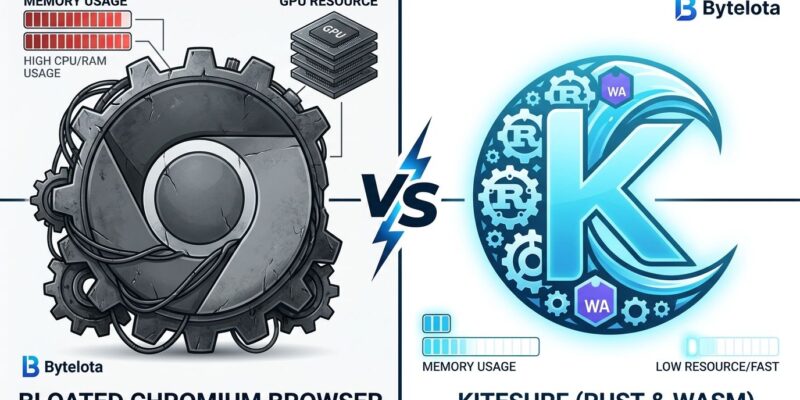
Chromium carries decades of human-facing overhead — tabs, extensions, GPU pipelines, sync infrastructure, pixel-perfect rendering for human eyes. None of that is useful to an AI agent extracting DOM structure or capturing a screenshot.
Cloudflare quantified the gap with hard numbers. To screenshot a single page, Chromium consumes 271 MiB of memory. Kitesurf uses 57.8 MiB — a 4.7x difference. For HTML extraction, the gap widens to 7x. On CPU time, Kitesurf runs 3.1–3.8x more efficiently. At scale — hundreds of parallel agent sessions — that cost difference compounds into something significant on your bill.
“AI doesn’t care about tabs, themes, browser extensions, or synchronization across devices. It cares about token count, context windows, scalability, performance, and costs.” — Cloudflare
This is Cloudflare’s core argument, and the benchmark numbers back it up. However, the performance story has a trade-off worth understanding before you commit.
Cloudflare Kitesurf’s Architecture: Three Isolated Components
The design is clean. Kitesurf runs as three separate Cloudflare Workers, each isolated from the others:
- Engine — The public interface. Handles CDP over WebSocket and HTTP REST, manages session state, and coordinates the other two components. It is the only stateful piece of the system.
- PageScript — A long-lived V8 isolate per page. Uses Blitz (a modular Rust rendering engine) and Stylo (Firefox’s CSS engine, also in Rust) for HTML and CSS parsing. JavaScript execution runs through Boa JS, a Rust ECMAScript engine that handles eval() since Cloudflare Workers doesn’t support it natively.
- PageRenderer — Rasterizes computed page objects into PNG, JPEG, or PDF output via the blitz-paint module with Parley for text shaping.
All external network traffic routes through a single SandboxOutbound worker, which enforces CORS, injects browser-shaped headers, isolates cookies per page, and blocks policy violations. Any component failure degrades gracefully to a blank frame — the session never dies. The Rust-to-WebAssembly path uses wasm-bindgen, not Emscripten — a deliberate choice, since Emscripten’s C/C++ emulation layer would reintroduce the overhead Kitesurf exists to eliminate.
The Honest Trade-off: Cheaper, Not Faster
Kitesurf is not faster than Chromium. Wall time for a screenshot is 1,148ms versus Chromium’s 637ms. For HTML extraction: 820ms versus 472ms. Kitesurf is roughly 1.7–1.8x slower on wall time. Cloudflare does not hide this — they state it directly in their documentation.
That trade-off matters depending on your use case. For batch screenshot pipelines or structured data extraction from hundreds of pages in parallel, the resource cost wins and the latency is acceptable. For anything requiring near-real-time response — interactive session handling, streaming — Chromium remains the right choice. Furthermore, Kitesurf currently does not handle video, WebGL, TLS-fingerprint bot challenge negotiation, or long authenticated sessions. Cloudflare’s recommendation: fall back to Chromium Browser Run for those scenarios.
On standards compliance, Kitesurf passes 235,000+ Web Platform Tests — 97% of DOM tests, 96% of HTML, 99% of Selection. It renders Wikipedia, Hacker News, TodoMVC across five frameworks, and reportedly runs Doom.
Getting Started: One Query Parameter
The adoption path is deliberately frictionless. If you already use Cloudflare Browser Run with Puppeteer or Playwright, switching to Kitesurf requires one query parameter: ?browser=kitesurf. CDP compatibility means zero code changes to your existing automation.
To take a screenshot immediately:
curl -X POST 'https://api.cloudflare.com/client/v4/accounts/<accountId>/browser-run/screenshot?browser=kitesurf' -H 'Authorization: Bearer <apiToken>' -H 'Content-Type: application/json' -d '{"url": "https://example.com"}' --output screenshot.pngFor MCP agents, the Cloudflare developer announcement includes configuration that routes CDP traffic through the Kitesurf endpoint instead of Chromium. Existing MCP clients work without modification. Additionally, a public playground at kitesurf.cloudflare.app lets you test site compatibility before committing to a switch. Kitesurf is free in beta, subject to per-account rate limits, with plans to open source the codebase — though no timeline has been published.
Key Takeaways
- 7x less memory for HTML extraction, 4.7x less for screenshots — Kitesurf wins on cost per session at scale
- 1.7–1.8x slower on wall time than Chromium — acceptable for batch/extraction workloads, not for real-time
- Drop-in CDP compatibility — Puppeteer, Playwright, and MCP clients work unchanged with one query parameter
- Not a Chromium replacement — no video, WebGL, bot challenges, or persistent auth; use Chromium for those
- Free in beta — available now through Cloudflare Browser Run
What This Says About the Web
Kitesurf is one piece of Cloudflare’s coordinated Agents Week announcements. In the same week, they shipped Cloudflare OS (a computer for agents), Cloudflare Wallets (a budget and identity layer), and WebMCP (making websites agent-readable by default). Kitesurf is the browser layer of that stack.
The argument underlying all of it: the web’s infrastructure was designed assuming human users. Moreover, if AI agents become the dominant consumers of web content — which is where the trajectory points — then the browser, the server model, the payment layer, and the identity layer all get redesigned from first principles. Kitesurf is what that redesign looks like at the browser level. The technical execution is sound, the benchmarks are real, and the CDP compatibility move eliminates adoption friction. Check it out at the Cloudflare Browser Run documentation.