 By ByteBot
AMD acquired Taalas today — the Toronto startup building chips where AI model weights are permanently etched into silicon at manufacturing time. No memory bandwidth bottleneck, no weight loading at runtime: the weights ARE the circuit. The HC1 chip runs Meta’s Llama 3.1 8B at 17,000 tokens per second — 74 times faster than the Nvidia H200 GPU, at roughly one-fifth the cost per million tokens. Financial terms were not disclosed; the deal closes Q4 pending regulatory approval.
This Is Not Faster Memory — The Weights Are the Chip
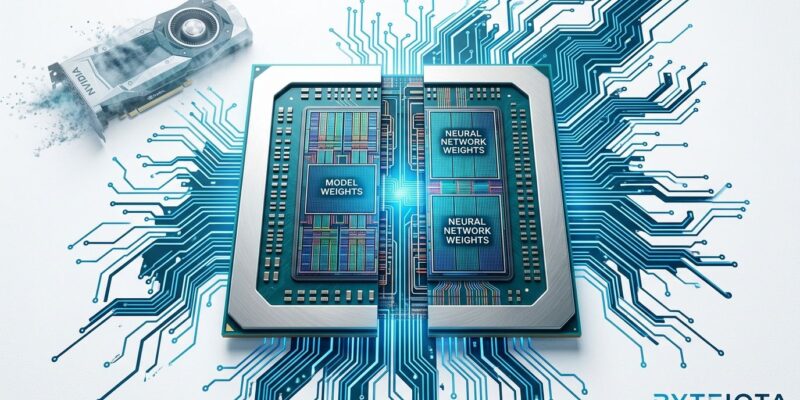
Every AI chip on the market today works the same way: model weights live in HBM memory and stream to compute units at inference time. Memory bandwidth is the fundamental bottleneck — most GPU cycles are spent waiting for data, not computing. Taalas’s Model-Specific Integrated Circuit (MSIC) eliminates this entirely.
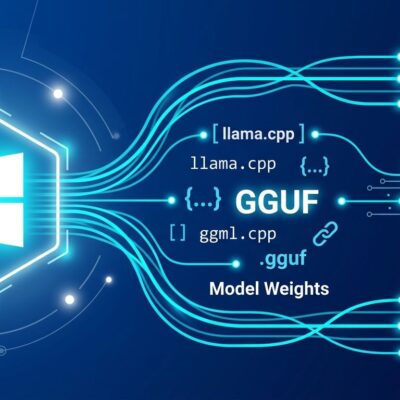
The HC1 embeds Llama 3.1 8B’s weights directly into a Mask-ROM recall fabric — a circuit structure where the model parameters are the physical connections on the chip. The HC1 carries 53 billion transistors on an 815mm² TSMC 6nm die, needs no HBM, requires no liquid cooling, and fits standard air-cooled server chassis. According to Heise Online’s technical breakdown, the performance gap against GPU-based inference is not incremental: Nvidia H200 achieves roughly 230 tokens per second on the same model; Groq’s LPU manages 609; Cerebras hits 1,936. Taalas claims 17,000.
Cost follows performance. According to chip analyst Karl Freund’s Forbes analysis of the HC1, inference costs drop to $0.0075 per million tokens — compared to $0.038–$0.20 per million on GPU alternatives. That is a 5-to-27x cost reduction. Power consumption drops by a factor of 10: 12-15 kilowatts per rack versus 120-600 kilowatts for GPU racks. At these economics, AI workloads that were unprofitable at GPU rates become viable. Real-time voice AI, agent chains with high sub-call volume, live translation — the math shifts substantially.
Related: Anthropic Custom Chip Team: What It Means for Claude Devs
The Lock-In Problem AMD’s PR Won’t Name
AMD SVP Vamsi Boppana said the company is building “a full-stack AI platform that gives customers the flexibility to deploy the right compute solutions for every AI workload.” Notice the word: flexibility. Taalas is the opposite of flexible, and that is not a bug — it is a fundamental architectural choice with serious implications for anyone evaluating this for production.
HC1 runs one model: Llama 3.1 8B. The weights are etched into silicon at fabrication. They cannot be patched, updated, or replaced. If your production workload needs Llama 4, or a different architecture entirely, you need new silicon. Taalas claims it can retool chips for a new model in approximately two months by modifying the final two metal layers — a legitimate differentiator from a full chip redesign. However, two months is a long retooling cycle when frontier models are shipping on a monthly cadence in 2026.
HC1 does support LoRA adapters via SRAM, allowing fine-tuning without new hardware. Context window sizes are configurable. Despite these accommodations, the base model weights remain immutable. Freund observed that despite Taalas’s performance claims, Meta has not switched from Nvidia — the operational complexity of managing multiple chip SKUs for different model versions is a real cost that raw performance numbers do not capture. The Register’s technical analysis frames it plainly: “extreme efficiency for a model that has stopped changing, at the price of flexibility.”
AMD’s Smart Play: Hybrid, Not All-In
AMD is not replacing Instinct GPUs with Taalas chips. The integration strategy uses a hybrid architecture: Instinct GPUs handle the prefill phase — processing the input prompt, which is highly variable — while Taalas MSICs handle token generation, the repetitive inference loop where specialized silicon delivers maximum advantage. This sidesteps the lock-in problem for the unpredictable portion of the workload while capturing Taalas’s economics where the bottleneck lives.
The HC2 chip targets winter 2026. It supports 20 billion parameter frontier models, corrects HC1’s aggressive 3-bit quantization (which introduces measurable accuracy degradation) with standard 4-bit floating-point formats, and uses pipeline parallelism across chips for larger model coverage. Furthermore, if HC2 delivers, AMD inherits a credible inference alternative to Nvidia’s B200 for workloads where the model has stabilized. Per the AMD acquisition announcement, the deal integrates Taalas across its Helios rackscale, Instinct GPU, EPYC CPU, and ROCm software stack.
Key Takeaways
- AMD acquired Taalas today (August 6, 2026) — the startup whose HC1 chip physically etches AI model weights into silicon, eliminating the memory bandwidth bottleneck that limits every GPU on the market
- HC1 runs Llama 3.1 8B at 17,000 tokens/sec — 74x faster than Nvidia H200, 10x less power, and 5-27x cheaper per million tokens by Taalas benchmarks
- The trade-off is absolute: HC1 runs one model forever; updating to a new model requires new silicon on a ~2-month retooling cycle — a significant constraint in 2026’s fast-moving model environment
- AMD’s integration plan is hybrid: Instinct GPUs for flexible prompt processing, Taalas chips for token generation — avoiding an all-in specialization bet
- HC2 (winter 2026) targets 20B parameter models with 4-bit float precision; developers building on stable, high-volume inference workloads should track this roadmap