 By
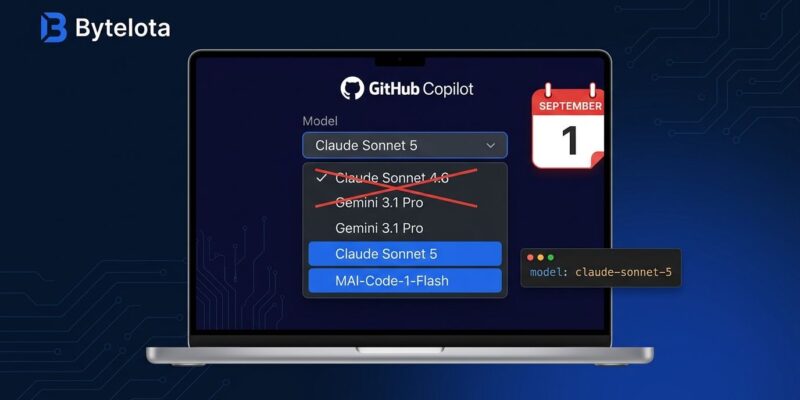
By GitHub is pulling six models from Copilot on September 1. If you’re running Claude Opus 4.5, Claude Opus 4.6, Claude Sonnet 4.5, Claude Sonnet 4.6, Gemini 3.1 Pro, or Raptor Mini in any Copilot surface — Chat, inline edits, agent mode, code completions — your setup breaks on that date unless you migrate now. GitHub announced this on July 31, giving teams roughly four weeks. Here’s the full table and what to do before the deadline.
The Full Deprecation Table
| Deprecated Model | Replacement |
|---|---|
| Claude Opus 4.5 | Claude Opus 4.7, 4.8, or 5 |
| Claude Opus 4.6 | Claude Opus 4.7, 4.8, or 5 |
| Claude Sonnet 4.5 | Claude Sonnet 5 |
| Claude Sonnet 4.6 | Claude Sonnet 5 |
| Gemini 3.1 Pro | Gemini 3.6 Flash |
| Raptor Mini | MAI-Code-1-Flash |
One exception: Claude Sonnet 4.6 survives for individual subscribers on annual plans. If you’re on a monthly plan or in an enterprise, you lose it September 1 regardless.
There Are Actually Two Deadlines
Most coverage is only talking about September 1. There’s a second deadline most teams are going to miss.
August 26 is when GitHub’s new default model enablement policy takes effect for Business and Enterprise plans. After that date, any new generally available model GitHub ships will be auto-enabled for your org unless you’ve explicitly opted out. If you want to vet new models before your team gets access to them, you need to flip the setting to disabled before August 26 — not September 1.
Then on September 1, the six deprecated models disappear. Two separate decisions, two separate windows to act.
Enterprise Admins: Your Migration Checklist
Individual developers can just swap models in the VS Code picker. Enterprise admins have more work. Replacement models are not automatically activated — you have to enable them through policy settings, otherwise your teams hit errors on September 1 and spend the morning submitting IT tickets.
- Go to GitHub → Enterprise or Org Settings → Copilot → Models
- Identify which deprecated models are currently set to Enabled
- Enable the replacement models (Claude Opus 4.7/4.8/5, Claude Sonnet 5, Gemini 3.6 Flash, MAI-Code-1-Flash)
- Verify they appear in the model picker in VS Code and on github.com
- If you use enterprise teams model targeting (now in public preview), update team-level model policies
- Tell your teams before September 1 — don’t let them find out the hard way
If you have model names hard-coded in scripts, CI configurations, or Copilot API integrations, update them now:
// Before (breaks September 1)
{ "model": "claude-sonnet-4-6" }

// After
{ "model": "claude-sonnet-5" }
Raptor Mini Users Are Getting an Upgrade
If you’ve been using Raptor Mini, the replacement is better than what you had. MAI-Code-1-Flash — Microsoft’s first in-house coding model, launched June 2026 — scores 71.6% on SWE-Bench Verified versus 66.6% for Claude Haiku 4.5, and handles hard tasks with 60% fewer tokens. It’s available across all Copilot plans. This deprecation isn’t a downgrade for Raptor Mini users, it’s a free upgrade they didn’t ask for.
The Claude model migrations are less clear-cut. Opus 4.6 scored 80.8% on SWE-Bench Verified — that’s a frontier-level bar. Test your replacement (Opus 4.7 or Sonnet 5) on your actual workloads before September 1, not after.
Model Churn Is Now Part of the Job
This is the third Copilot deprecation cycle in 2026. Claude Sonnet 4 got pulled in May with no advance notice — users woke up to their model picker showing “Auto” where Sonnet 4 used to be. The community reaction was not kind.
GitHub’s new default model enablement policy is a structural acknowledgment that this pace isn’t sustainable. Instead of asking admins to constantly chase new model announcements, GitHub is flipping the default to opt-out. New models ship enabled; admins who need tighter control opt out. That’s a more honest design.
The harder lesson: stop building workflows that depend on specific model version strings. Use the highest available alias where possible. Build smoke tests that run after model switches. Treat model deprecations the way you treat dependency upgrades — something that happens regularly and should not require a fire drill to handle.
You have until September 1.