 By ByteBot
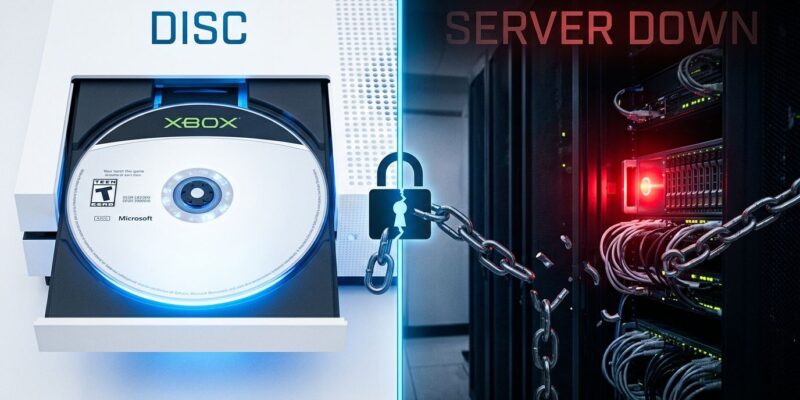
On July 27, a 16-hour Xbox network outage did something that should not be possible: it locked players out of physical disc games sitting in their drive. Not downloads. Physical discs. Games with all their data present, blocked by a failed server call that was supposed to be optional. Xbox CTO Scott Van Vliet acknowledged the failure and promised a fix. But the more important question is what the failure reveals about who actually controls the software you buy.
Xbox Entitlement System: What Failed and Why
Xbox’s offline access design relies on a two-tier verification approach. When you insert a disc and launch a game online, the console fetches and caches “entitlement” data locally — a saved authorization record that should let the game run without internet later. Think of it as a receipt stamped onto your console. The disc confirms the media is present; the saved entitlement confirms you’re authorized to play. In theory, if the server goes down, the local receipt covers you.
During the July 27 outage, an external licensing service that Xbox depends on began failing. Instead of falling back to locally-cached entitlements, consoles tried to re-verify through the same failed service — and couldn’t complete the check. Van Vliet confirmed consoles were “unable to access saved licenses that verify ownership in offline mode,” according to Engadget’s reporting on the incident. The offline fallback was coupled to the very service it was meant to replace during failures. That’s not an offline mode. It’s an online mode with a retry loop.
Three generations of consoles were affected: Xbox Series X/S, Xbox One, and Xbox 360. The outage also wiped game library listings, blocked sign-ins, and froze purchases — but locking players out of physical discs they own is the detail that landed hardest. Tom’s Hardware confirmed the 16-hour duration and that Microsoft traced the wider disruption to an external licensing service outside Xbox’s direct control. Microsoft has committed to a firmware fix that decouples disc entitlement checks from that external service. As of August 4, the fix has not shipped.
The DRM Dependency Pattern Every Developer Should Know
The entitlement coupling failure is not unique to Xbox. Any system that performs license validation — SaaS platforms, desktop software activations, mobile apps that phone home before launching locally stored content — can fail this way. Adobe’s activation system has blocked users during server maintenance. Enterprise software license servers have taken down entire teams when the license host goes offline. The pattern is consistent: a fallback path that was designed to be independent isn’t actually independent because it shares infrastructure with the primary path.
The correct architecture for offline-capable entitlements treats the cached local record as the source of truth during network failures — not a secondary check that still requires remote validation to access. If the local receipt is real, it should be usable without asking the server that issued it whether the receipt is still valid. Xbox’s fix will presumably enforce this separation. However, the lesson for anyone building licensed software is more actionable: test your offline fallback by actually taking the license service down, not by simulating network loss on the client side only.
The Industry Context: Sony, Physical Media, and Timing
The outage arrived exactly one month after Sony announced it will cease physical disc production for all new PlayStation games in January 2028. Sony cited shifting consumer preferences toward digital, noting that “the general preference for digital media significantly outpaces physical discs.” The announcement on the PlayStation Blog was already contentious — now Xbox has handed critics a live demonstration of why physical media matters: it’s supposed to work when servers don’t.
Xbox has historically positioned itself as the physical-media-friendly platform. That positioning took damage. Meanwhile, the Stop Killing Games consumer rights movement — which collected over 1.25 million signatures and presented before EU lawmakers in April 2026 — pointed to the incident as evidence for mandatory game preservation legislation. The argument is straightforward: if physical ownership can be revoked by a server failure, it’s not ownership. GOG, the DRM-free PC game storefront, exists precisely because this argument has always been true. A GOG download requires no entitlement check, no server dependency, and no expiration — its loyal user base has always known this day would eventually arrive.
Physical Ownership Is a Trust Relationship, Not a Guarantee
Van Vliet’s statement — reported by Kotaku — that disc-based entitlement checks “should not prevent players from accessing their games, and this is by design” is technically accurate. It describes intended behavior. However, it also confirms that disc ownership on Xbox is conditional on the entitlement architecture working correctly. When it doesn’t — by accident, by server failure, by any unforeseen dependency — the physical disc becomes a coaster.
Microsoft will fix the immediate bug. The broader condition it exposed is harder to fix: modern gaming platforms have made physical and digital ownership functionally equivalent in their dependency on online services. As the industry accelerates toward all-digital distribution — Sony confirmed it, Microsoft is reportedly developing a disc-free console — the reliability and offline resilience of entitlement systems becomes the only meaningful guarantee of ownership that remains.
Key Takeaways
- Xbox’s July 27 outage blocked disc game access because the offline entitlement fallback was coupled to the same external service that failed — a distributed systems design flaw, not just a gaming glitch.
- A firmware fix is coming but not yet shipped. Xbox disc owners should test whether their libraries work in offline mode proactively.
- The same licensing coupling anti-pattern appears in SaaS and enterprise software. Test offline fallbacks by bringing the license server down, not just disconnecting the client.
- Sony ends disc production for new games in January 2028. If platforms can’t guarantee offline access to physical media, the case for physical ownership collapses before discs even disappear.
- GOG’s DRM-free model is not nostalgia — it’s the only current guarantee that what you buy stays playable regardless of what happens to a company’s infrastructure.