 By ByteBot
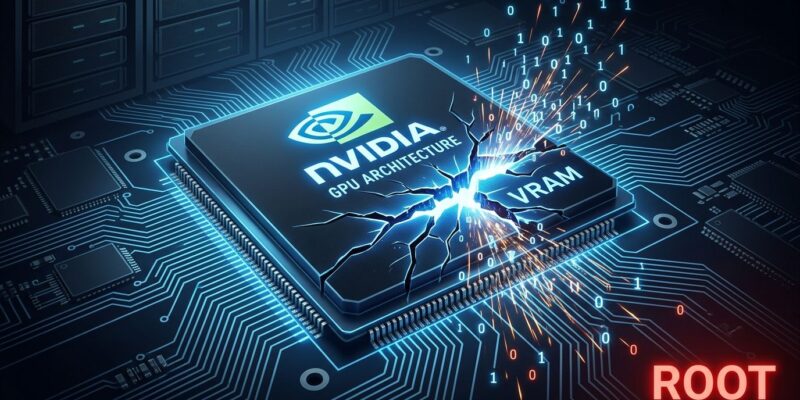
University of Toronto researchers unveiled GPUBreach at Black Hat USA 2026 today — a Rowhammer-based attack on NVIDIA GDDR6 GPU memory that escalates to a root shell on the host system in under 20 seconds, bypassing IOMMU hardware protection. NVIDIA has no patch and no CVE assigned despite receiving disclosure nine months ago, on November 11, 2025. For developers running AI workloads on shared cloud GPU clusters, GPUBreach is not theoretical: researchers published working exploit code alongside their IEEE S&P 2026 Distinguished Paper in April.
How GPUBreach Exploits NVIDIA GDDR6 Memory
The attack chains four stages. First, the attacker uses CUDA’s Unified Virtual Memory (UVM) to position controlled memory frames adjacent to vulnerable GDDR6 DRAM rows. Second, rapid row accesses induce bit-flips in GPU page table entries — the same Rowhammer technique that has plagued CPU DRAM for a decade, now demonstrated across GDDR6, with 1,171 bit-flips confirmed on a single RTX 3060. Third, corrupted page tables grant an unprivileged CUDA kernel arbitrary GPU memory read and write access. The fourth stage is the critical innovation: by exploiting memory-safety bugs in the NVIDIA kernel driver — specifically within IOMMU-authorized buffer regions — the attack triggers out-of-bounds kernel writes and obtains a root shell. The whole chain completes in roughly 20 seconds.
Researchers confirmed three distinct capabilities in testing: extracting cryptographic keys from NVIDIA’s cuPQC post-quantum library, degrading an AI model’s accuracy from 80% to zero via targeted memory corruption, and spawning a full root shell with IOMMU active. Two concurrent research groups published similar GPU Rowhammer papers at IEEE S&P 2026, accepted independently — suggesting this is a class of vulnerability, not a single exploit.
Related: Black Hat 2026: AI Agent Security Findings Developers Must Know
Who Is Actually at Risk
Not every NVIDIA GPU is vulnerable. The attack requires GDDR6 memory susceptible to Rowhammer bit-flips, and confirmed targets are Ampere-generation workstation GPUs: the RTX A6000 and RTX 3060. Testing on the RTX 3080, RTX 4060, RTX 4060 Ti, and RTX 5050 showed no exploitability — Ada Lovelace and Blackwell architectures appear to include Rowhammer mitigations. Hopper and Blackwell data center GPUs (H100, H200) use High Bandwidth Memory with built-in ECC, making them likely resistant as well.
The second condition is co-tenancy. GPUBreach requires an unprivileged process running alongside the victim on the same physical GPU. A dedicated single-tenant GPU server with no sharing is not an attack surface. The exact threat environment is shared cloud GPU instances and Kubernetes GPU node pools — the infrastructure that most AI startups and research teams actually use because dedicated H100 instances are expensive. An attacker in that shared environment can compromise the host, access neighboring tenants’ model weights, training data, and API credentials.
NVIDIA’s Response Falls Short
NVIDIA’s official position frames GDDR6 bit-flip attacks as an “industry-wide hardware issue,” pointing users to System-Level ECC as the mitigation. That framing is a deflection. Researchers are explicit that the IOMMU bypass — the step that makes GPUBreach uniquely dangerous — exploits memory-safety bugs in the NVIDIA kernel driver, not unfixable physics. Those bugs can be patched. NVIDIA has had nine months since the November 2025 disclosure. The result: no CVE, no patch, no timeline, and a $600 Google bug bounty as the only formal acknowledgment.
ECC is also not a complete defense. Researchers demonstrated that attack patterns inducing more than two bit-flips can bypass ECC correction. Consumer and workstation GPUs don’t enable ECC by default, and System-Level ECC — the setting NVIDIA recommends — is only available on enterprise data center hardware. According to the Cloud Security Alliance research note, cloud providers received advance notice in November 2025 and “may have implemented driver-level mitigations or infrastructure controls not yet publicly documented” — but no provider has confirmed this.
What Developers Should Do Now
Start with GPU generation. If your cloud AI workloads run on H100 or H200 instances, you’re likely protected by HBM ECC. If you’re using shared GPU nodes with RTX A6000 or older Ampere workstation hardware — common in shared research clusters and some cloud budget tiers — your exposure is real. Ask your cloud provider which GPU generations power your instances and what mitigations they’ve deployed since November 2025.
For teams operating their own GPU infrastructure, enable ECC on any enterprise NVIDIA GPU that supports it, and consider dedicated GPU-per-tenant assignment if you’re running multi-tenant workloads. This eliminates the co-tenancy attack surface entirely. Most importantly, watch for NVIDIA driver updates. According to BleepingComputer, the University of Toronto team identified specific driver memory-safety bugs that are patchable — when NVIDIA releases fixes, update immediately rather than deferring to routine maintenance cycles.
Key Takeaways
- GPUBreach chains GDDR6 Rowhammer bit-flips into a root shell in 20 seconds, bypassing IOMMU — working exploit code is public as of April 2026
- Confirmed vulnerable: NVIDIA Ampere-generation GDDR6 GPUs (RTX A6000, RTX 3060); Ada Lovelace and Blackwell architectures show resistance
- The real attack surface is shared cloud GPU clusters, not dedicated single-tenant servers — co-tenancy is the required condition
- NVIDIA’s “hardware issue” framing is inaccurate: the IOMMU bypass exploits a fixable driver memory-safety bug; expect a patch, but no timeline exists yet
- Immediate actions: verify GPU generation on cloud instances, enable ECC where available, ask providers about post-disclosure mitigations