 By ByteBot
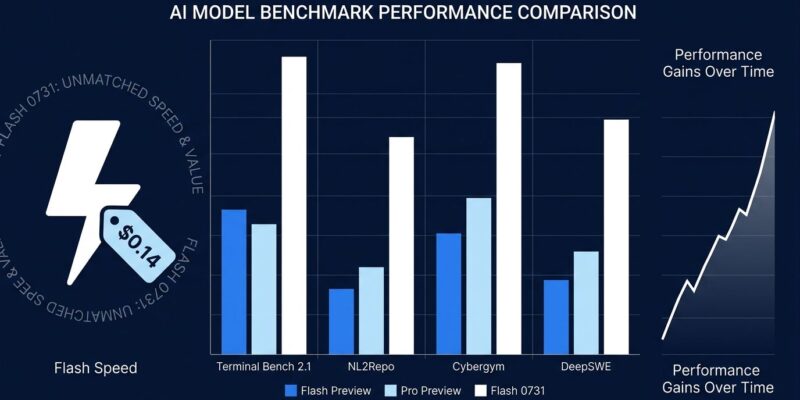
DeepSeek released its V4-Flash-0731 API into public beta today, July 31, 2026 — and the benchmarks are hard to ignore. On Terminal Bench 2.1, the model scores 82.7, up from 61.8 in the preview build. That puts it above V4-Pro-Preview at 72.1 — a Flash model outperforming the Pro variant on the benchmark developers use for agentic coding tasks. On DeepSWE, Flash jumped from 7.3 to 54.4, a 7x improvement in a single post-training cycle. Claude Opus 4.8 scores ~85.0 on Terminal Bench, for context. The price remains $0.14 per million input tokens.
Flash Beats Pro on Agent Benchmarks — and the Gap Is Not Small
DeepSeek’s official API changelog is blunt about what changed: “V4-Flash-0731 keeps the same model architecture and size as V4-Flash-Preview, and was only re-post-trained.” Same weights, different fine-tuning. That post-training was clearly targeted at agentic tasks. Every benchmark published today shows Flash 0731 surpassing V4-Pro-Preview.
| Benchmark | Flash Preview | Flash 0731 | Pro Preview |
|---|---|---|---|
| Terminal Bench 2.1 | 61.8 | 82.7 | 72.1 |
| NL2Repo | 39.4 | 54.2 | — |
| Cybergym | 38.7 | 76.7 | — |
| DeepSWE | 7.3 | 54.4 | — |
The Cybergym result deserves a double take — 38.7 to 76.7 is nearly double in one update. DeepSWE going from 7.3 to 54.4 is not a rounding error; it signals that the post-training specifically targeted software engineering agent tasks. When a Flash model beats the Pro on what Pro is supposed to excel at, you have to ask what the Pro is for. The answer right now: wait for the official V4-Pro release, which is coming soon.
Codex Integration: DeepSeek V4 Flash Gets There First
V4-Flash-0731 is also the only DeepSeek model that currently supports OpenAI’s Codex integration and the Responses API format. V4-Pro Codex support is expected in early August. According to DeepSeek’s Codex integration documentation, the Responses API offers “more flexible tool calls, more complex multi-round interactions, and more fine-grained output control” compared to standard Chat Completions — which makes Flash the better choice right now for agentic pipelines built on Codex.
For developers already on the V4-Flash preview, upgrading to the stable public beta requires exactly one code change:
# Before (V4-Flash preview)
client.chat.completions.create(model="deepseek-v4-flash-preview", ...)

# After (V4-Flash public beta — July 31, 2026)
client.chat.completions.create(model="deepseek-v4-flash", ...)
Everything else stays the same. No API restructuring, no credential changes.
The Cost Math: $0.14 vs. the Field
V4-Flash-0731 costs $0.14 per million input tokens and $0.28 per million output tokens. That is 3.1x cheaper than V4-Pro ($0.435/$0.87) and 7x cheaper than GPT-5.6 Luna ($1.00/$6.00). Claude Sonnet 5 is $3.00/$15.00 — over 21x the input cost. Even GPT-5.4 Nano, OpenAI’s cheapest model, charges $0.20/$1.25. According to BenchLM.ai’s pricing comparison, cache-hit pricing drops V4-Flash to $0.0028 per million input tokens, making it nearly free for repeated system prompts. Output throughput is 81.3 tokens per second, compared to 35.6 tok/s for Pro — 2.3x faster.
Consider what this means for high-volume workloads. A team spending $1,000 a month on Claude Sonnet 5 could, in theory, run equivalent V4-Flash-0731 workloads for around $47. That kind of cost delta changes what agentic products are economically viable to build. DeepSeek is not squeezing margins — it is shifting the floor.
Two Caveats Worth Knowing Before You Switch
First: data processed through DeepSeek’s hosted API goes to servers in China, subject to Chinese law — including the National Intelligence Law, which compels organizations to cooperate with state intelligence requests. For regulated industries (GDPR, HIPAA, government), the hosted API is not appropriate. The open-weights release, confirmed by TechNode, is available on HuggingFace under MIT license and provides a self-hosting path, but you will need at minimum a single H100 for FP8 inference, or roughly 170 GB VRAM for full weights. Consumer GPU support via llama.cpp and Ollama is not stable yet.
Second: this is still public beta. DeepSeek has not published enterprise SLA terms. For workloads where uptime guarantees matter, the API is usable but not certified. The official V4-Pro release, and V4-Pro’s Codex integration, are both expected in August — so the current state is not the final word.
Key Takeaways
- V4-Flash-0731 outperforms V4-Pro-Preview on every agent benchmark published today — Terminal Bench 2.1 (82.7 vs 72.1), DeepSWE (54.4 vs Flash’s prior 7.3). A Flash model beating the Pro is the headline.
- Codex integration is available now on V4-Flash only; V4-Pro support arrives in early August. Upgrading from preview to public beta requires changing one line of code.
- At $0.14/M input, V4-Flash is 3.1x cheaper than V4-Pro, 7x cheaper than GPT-5.6 Luna, and 21x cheaper than Claude Sonnet 5 — while now matching near-frontier agent performance.
- The hosted API sends data to China-based servers. Teams with regulated data should self-host via the MIT-licensed HuggingFace weights, which require H100-class hardware.
- The official V4-Pro release is forthcoming. Today’s update makes V4-Flash the rational default for agent workloads until then.