 By ByteBot
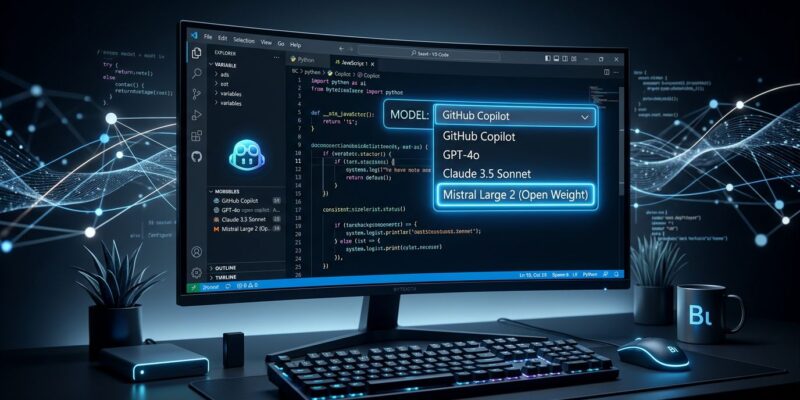
GitHub just added its first open-weight AI model to the Copilot model picker. Kimi K2.7 Code from Moonshot AI went generally available on July 1, and the implications reach further than a new option in a dropdown. For the first time, Copilot users can select a model whose weights are publicly auditable — not just trusted on vendor benchmarks. If you work in a regulated industry, that distinction matters more than most benchmark numbers.
Why Open-Weight in Copilot Is Different
Every model in Copilot’s picker until now has been proprietary: OpenAI, Anthropic, Google, and Microsoft. You either trusted those vendors’ data handling and security posture, or you didn’t use Copilot. Open-weight changes the calculus.
Because Kimi K2.7 Code’s weights are MIT-licensed and publicly available on Hugging Face, security and compliance teams can inspect what they’re running — or commission a third-party audit — rather than accepting a vendor’s attestation. That matters for finance, healthcare, and defense shops where “we audited the model” is a real procurement requirement, not a nice-to-have.
The data residency question is worth addressing upfront: when you use Kimi K2.7 through Copilot, inference runs on Microsoft’s Azure infrastructure. Your code does not reach Moonshot AI’s servers. The Chinese-lab concern that immediately comes to mind is addressed at the infrastructure layer.
The Model: Trillion Parameters, 32 Billion Active
Kimi K2.7 Code uses a Mixture-of-Experts architecture: 1 trillion total parameters, with only 32 billion activating per token. That means you get the representational breadth of a trillion-parameter model at roughly the compute cost of a 32-billion-parameter dense model. It’s how Moonshot AI achieves GPT-5.5-class coding performance while pricing the API at $0.95 per million input tokens — around one-sixth the cost of comparable proprietary models.
Against its predecessor, K2.7 Code posts meaningful improvements: +21.8% on Kimi Code Bench v2, +31.5% on MLS Bench Lite. It also uses roughly 30% fewer thinking tokens, which means lower credit burn per coding task when it lands in Copilot’s AI credit billing. The context window sits at 256K tokens with a MIT license — more permissive than most open-weight releases.
How to Access It
Individual plans (Pro, Pro+, Max): Open the model picker in VS Code and Kimi K2.7 Code should appear. The rollout is gradual — if it’s missing today, check again tomorrow. It’s also available in Visual Studio 17.14.6+, JetBrains 1.9.1-251+, Xcode, Eclipse, GitHub.com, Copilot CLI, and GitHub Mobile on both platforms.
Business and Enterprise plans: The model is off by default for Business and Enterprise. An administrator must explicitly enable the Kimi K2.7 Code policy in Copilot settings before any user in the organization can select it. GitHub’s decision to require opt-in is deliberate — giving enterprises control over which models their teams can use, rather than exposing every new addition automatically.
The Five-Lab Picker and What Comes Next
With Kimi K2.7’s arrival, GitHub Copilot’s roster now spans five AI labs: OpenAI, Anthropic, Google, Microsoft, and Moonshot AI. That’s the broadest model set any major coding tool has assembled under a single subscription. The model picker is quietly becoming a model marketplace — and Kimi K2.7 normalizes the idea that enterprise-grade coding assistance doesn’t have to come from a US-based proprietary lab.
Kimi K3 is scheduled to drop open weights on July 27. If K2.7 landed in Copilot 19 days after its weights shipped, the cadence for K3 is straightforward to estimate. After that, Meta’s Llama and Mistral models seem like natural candidates for the picker. The trajectory is clear: GitHub is building a curated marketplace, and “open-weight” is now a first-class option in it.
Check the GitHub Copilot supported models documentation for the full current roster. If you haven’t opened your model picker lately, now is a good time. The options there are starting to matter.