 By ByteBot
Redis 8.2 is generally available, and most coverage has focused on the throughput numbers. That is fair — 49% more operations per second is hard to ignore. But the improvement buried at the bottom of the release post is the one that should change how you think about Redis in 2026: up to 67% memory reduction for JSON numeric fields. You expect a new Redis release to go faster. You do not expect it to quietly cut your JSON memory bill by two-thirds.
What Actually Changed: The kvobj Architecture
The performance improvements in Redis 8.2 are not the result of surface-level tuning. They come from a fundamental restructuring of how Redis stores data internally.
Previous versions stored each key-value pair using multiple separate memory allocations: a dictEntry holding three pointers (24 bytes on 64-bit systems), a redisObject wrapper (16 bytes), and separate SDS string headers for key and value. Every access required traversing multiple pointers — punishing for CPU cache locality.
Redis 8.2 replaces this with kvobj — a single, tightly packed allocation that embeds the key name, value, and optional TTL into one memory block. The knock-on effects:
- 25–37% memory reduction for short string keys
- TTL lookups are now O(1) instead of a separate hash table lookup
- Fewer pointer dereferences means better CPU cache performance across all operations
This architecture is what drives most of the headline numbers in this release.
The Throughput Story
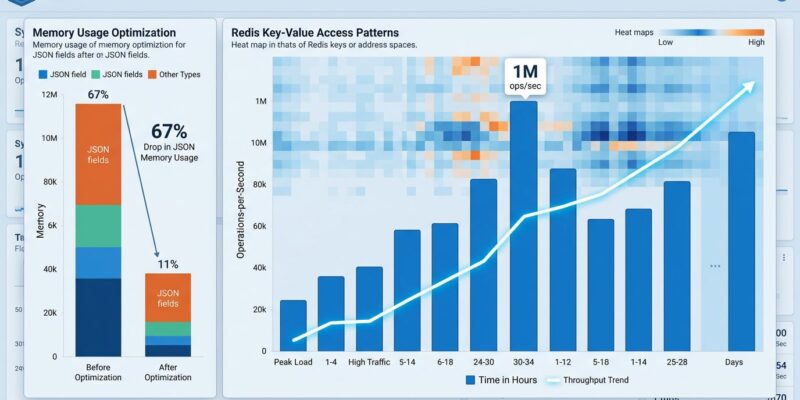
With 8 I/O threads enabled and a realistic 80/20 read-write workload, Redis 8.2 delivers 49% more throughput than Redis 8.0 on the same hardware. In absolute terms: a single Redis 8.2 instance now exceeds 1 million operations per second.
Enabling it requires two lines in your redis.conf:
io-threads 8
io-threads-do-reads yes
No code changes. Your existing client libraries — go-redis, redis-py, Jedis, Lettuce, node-redis — work without modification.
Beyond threading, over 70 commands have been individually optimized. The most significant:
- BITCOUNT: 35% faster via prefetching optimizations
- LINSERT, LREM, LPOS: 25%+ latency reduction by caching string-to-integer conversions during list comparisons
- 17 additional commands with 5%+ improvement; 52 more with 2%+ improvement
No changes needed to capture these gains — they apply on upgrade.
The JSON Angle Most Teams Will Miss
Most Redis workloads in 2026 involve JSON: API response caches, AI feature stores, analytics pipelines. JSON containing numeric fields is the dominant data shape. And that is exactly where Redis 8.2 delivers its most dramatic, underreported improvement.
Redis 8.2 changes how integers and floats are stored inside JSON documents — numeric values are now inlined directly into the document structure rather than allocated separately. The result: 25–67% memory reduction for JSON with numeric fields. Financial records, analytics payloads, and AI feature vectors are immediate beneficiaries.
If you are storing model scores, inference results, or embedding metadata in Redis, this is a meaningful infrastructure cost reduction that requires zero application changes. According to the Redis 8.2 release announcement, financial records and analytics datasets see the largest gains.
For reference: Redis 8.4 extends this further. Homogeneous numeric arrays — like vector embeddings — can see up to 92% memory reduction in that release. If you are running vector search workloads, plan accordingly.
The Valkey Question
Valkey forked from Redis 7.2 in 2024 and is now the default Redis-compatible store in Debian, Ubuntu, and RHEL. If you have not made a deliberate choice between Redis and Valkey yet, Redis 8.2 forces that decision.
The kvobj architecture, command optimizations, and JSON memory improvements do not exist in Valkey — it is still on Redis 7.2 internals. If you are self-hosting and care about raw performance, and you are not blocked by the AGPL license, Redis 8.2 is the stronger technical choice today. The official Redis 8.2 documentation covers the full feature delta.
If you are on a managed service, check your provider timeline. Azure has not rolled out Redis 8.2 support yet as of this writing. Redis Cloud has it. AWS ElastiCache and Google Memorystore timelines vary.
Should You Upgrade Now?
If your workload is dominated by short string caching and JSON: yes. The memory savings alone justify it. Run a baseline before upgrading:
redis-benchmark -n 1000000 -c 50 -t get,setRedis 8.2 supports in-place upgrades from Redis 6.2, 7.2, 7.4, and 8.0. If upgrading from 7.x, review the full release notes on GitHub for the 8.0 breaking changes first — most are minor, but worth checking before touching production. From 6.x, plan for an intermediate stop at 7.x.
The 1 million ops/sec figure requires 8 I/O threads and a specific workload shape. Benchmark your actual traffic patterns, not synthetic maximums. The directional improvement — faster commands, smaller memory footprint, better JSON efficiency — applies broadly regardless of configuration.
Redis 8.2 is not a flashy release. It does not add a headline data type or a new protocol. What it does is make the Redis you are already running measurably more efficient. That is often the most valuable thing a database release can deliver.