 By ByteBot
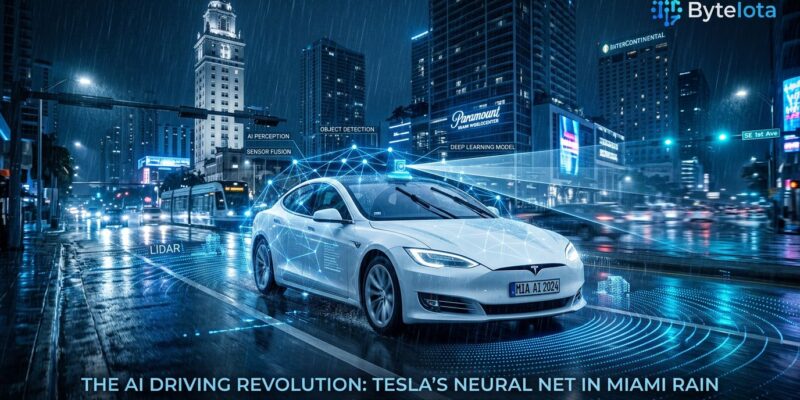
Tesla launched its driverless Robotaxi service in Miami on July 3 — skipping the human safety-monitor phase it used in every prior city. The timing deserves scrutiny: four months ago, NHTSA upgraded its probe of Tesla’s camera-only Full Self-Driving system to engineering analysis status, finding it “fails to detect and/or warn the driver appropriately under degraded visibility conditions such as glare and airborne obscurants.” Miami, known for sudden tropical downpours and punishing sun glare, is precisely the environment regulators are scrutinizing. Tesla launched into it anyway.
What NHTSA Is Actually Investigating
Engineering analysis (EA26002, March 2026) is the step directly before NHTSA can seek a formal recall. The scope covers 3.2 million vehicles. The specific failure: Tesla’s camera-only system cannot reliably detect degraded visibility — rain, glare, fog, dust — and doesn’t adequately warn drivers when it can’t see clearly. NHTSA opened a preliminary evaluation in October 2024 after identifying four crashes in reduced-visibility conditions, one fatal. Nine incidents are now on record. The March escalation means the agency has gathered enough evidence to move toward a formal enforcement decision.
Tesla removed radar from its vehicles in 2021 — against the advice of some of its own engineers, who warned cameras alone would struggle with environmental interference. Elon Musk famously dismissed LiDAR as “stupid, expensive, and unnecessary.” That bet is now under federal review while the commercial fleet expands.
Miami Is the Test, Not the Proof
Tesla didn’t just launch in a warm-weather market. It launched in the warm-weather market most likely to surface the exact failure mode its federal probe is about. South Florida averages 60 inches of rain a year, with afternoon thunderstorms that can reduce visibility to near zero in minutes. The FSD software has been trained on over 100,000 Florida thunderstorm clips harvested from Tesla’s fleet over two years — which either means Tesla is confident it’s solved the problem, or it means the company knows this is the real test and wants to run it commercially.
Early reports from launch day are cautiously positive: vehicles operated in rainy conditions without disengagements, though riders noted the cars hesitated at flooded intersections before proceeding. The service zone covers 10 to 14 square miles of western Miami-Dade. That’s four days of data. It’s not exoneration; it’s the beginning of the experiment.
The Scale Problem
Tesla’s Miami launch gets framed as expansion. The numbers tell a more complicated story. According to NHTSA filings, Tesla has 42 registered driverless vehicles in Texas — its most established market. Waymo has 577 in the same state. Nationally, Tesla operates in four cities; Waymo runs in 10-plus metro areas with 500,000-plus weekly rides, targeting 1 million by year end.
Tesla’s 10 billion cumulative FSD miles (hit in May 2026) sounds impressive until you account for the category: those are Level 2 miles, meaning a human was present and responsible for the vehicle. Waymo’s comparable figure is Level 4 — no human backup. The miles are not equivalent, and comparing them directly is how you misread the competitive landscape.
Austin’s safety record adds texture: 17 incidents between July 2025 and March 2026, two caused by the teleoperator (remote human taking control), not FSD. Most others involved other drivers hitting a stopped Tesla. That record was accumulated with safety monitors present. Miami removes them.
What Tesla Is Actually Banking On
FSD v15 is the real play. The current system runs on roughly 1 billion parameters. v15 is a full architectural rewrite targeting 10 billion — a 10x jump — with a timeline of late 2026 or early 2027. Musk has said openly that aggressive fleet scaling doesn’t make sense until v15 is ready. Miami may be less about genuine expansion and more about demonstrating forward momentum while the company waits for the system it believes will resolve the regulatory questions.
That’s a defensible strategy, but it means the Miami deployment is a prototype network — a live test with real passengers, in real weather, under a federal investigation covering 3.2 million vehicles.
Why This Matters Beyond Tesla
Camera-only versus sensor fusion is the defining unresolved question in commercial autonomy. Waymo’s LiDAR generates 3D point clouds that function in rain, glare, and dust. In comparative tests, a Luminar LiDAR-equipped vehicle passed all six visibility challenges; Tesla passed three. That result isn’t definitive — real-world data over millions of miles matters more than controlled tests — but it’s what regulators have to work with today.
How Miami performs over the next several months will matter. NHTSA is watching. If Tesla’s camera-only system handles tropical weather without incident, it strengthens the case that training data scale can compensate for sensor limitations. If it doesn’t, the recall risk covering 3.2 million vehicles becomes very real — and the camera-only architecture faces a regulatory wall that no amount of parameter scaling can immediately fix.