 By ByteBot
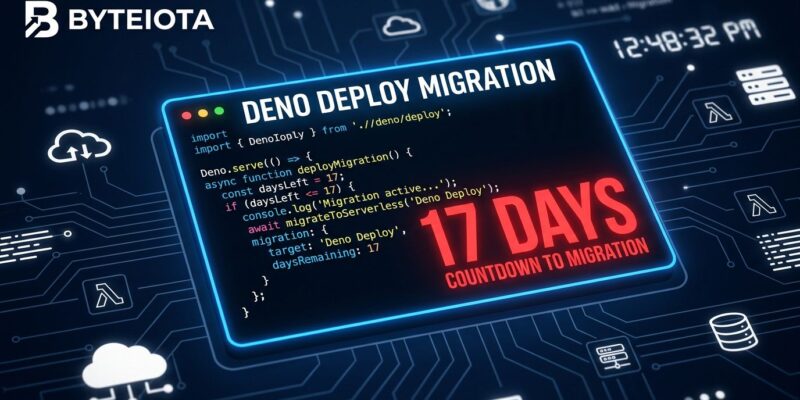
Deno Deploy Classic shuts down on July 20, 2026. Not deprecated — shut down. Any project still running at dash.deno.com goes dark that day. You have seventeen days, and the migration involves more than pointing a config at a new URL. There is a breaking API change that fails silently, a queue system that simply does not exist in the new platform, and a KV migration that requires emailing support. Here is everything you need to know to get out before the lights go off.
You Start From Scratch
Your Classic projects do not transfer to the new platform at console.deno.com. Nothing migrates automatically. You create a new organization — pick the name carefully, it cannot be changed — create a new app, reconnect your GitHub repository, and re-enter every environment variable. The new platform separates env vars by context (production, development, build), which is an improvement, but it means a manual re-setup for every project. Custom domain changes require CNAME updates with up to 48 hours of DNS propagation. If you are running anything time-sensitive, start the domain migration today.
Fix This One Line or Your App Will Silently Fail
The most impactful breaking change is the HTTP server API. Deploy Classic supported the legacy serve() function from the deno.land/std library. The new platform does not. Apps using it will timeout during the warmup stage with no helpful error message — just a failed deployment.
Replace this:
import { serve } from "https://deno.land/std@0.170.0/http/server.ts";
serve(() => new Response("hello, world"));
With this:
Deno.serve(() => new Response("hello, world"));Search your codebase for deno.land/std imports of serve and update them before redeploying. One line. Don’t let it surprise you.
Queues Are Gone and There Is No Built-In Replacement
If your app uses Deno.Kv.enqueue() or Deno.Kv.listenQueue(), you have a harder problem. Deno Queues are not supported on the new platform — no compatibility shim, no migration path within Deno’s ecosystem. You will need to replace them with an external queue service before migrating. Common alternatives include Upstash QStash, Redis with BullMQ, or AWS SQS. This is not a fast change if your application relies on queues for background jobs or async processing.
deployctl Is Retired; Switch to deno deploy
The deployctl CLI tool used by many CI/CD pipelines is being retired alongside Classic. The replacement is the deno deploy subcommand built directly into the Deno runtime. For teams that build elsewhere — GitHub Actions, for example — and deploy pre-built artifacts: the new platform expects builds to happen inside its environment by default. You can opt into self-hosted CI/CD, but it requires explicit configuration. The official migration guide covers the updated deployment approach in detail.
What Actually Gets Better
The new Deno Deploy is not a lateral move. The platform runs full Deno 2.0, adding FFI, subprocesses, and filesystem write access that Classic never supported. npm compatibility is substantially better. Built-in OpenTelemetry auto-instruments HTTP requests without configuration. The --tunnel flag connects local development to your production environment variables. OIDC Cloud Connections handle AWS and GCP authentication without credential files. These are meaningful improvements — the platform itself is better. The migration path is the problem.
Gotchas Before You Go Live
The new platform runs in two regions — US and Europe — down from six on Classic. Asia-Pacific users will see a latency regression until Deno expands coverage. Existing KV databases do not migrate automatically; contact support@deno.com for assistance. A community feedback thread has flagged unexpected memory usage on the new platform — one static site consumed 10.5 GB/hour RAM in under 24 hours. Monitor your resource usage closely in the first 48 hours after migration. The one bright spot: cron jobs work identically and require zero code changes.
The Clock Is Running
Seventeen days sounds manageable until you account for DNS propagation, KV migration coordination, queue replacement architecture, and whatever CI/CD adjustments your team needs to make. The new platform’s feature improvements are real, but the migration gap — no queue support, manual KV transfers, fewer regions — shows a platform that was not quite ready to absorb its own user base without friction. That is Deno’s problem to fix. Your problem is getting your projects migrated before July 20. Start today.