 By
By Anthropic dropped their “Effective Context Engineering for AI Agents” guide this month, and it comes paired with a number from their 2026 Agentic Coding Trends Report that should stop every agent builder cold: teams that master context engineering complete tasks 55% faster and make 40% fewer errors than those that don’t. Not because they found better prompts. Because they stopped treating the context window as an afterthought and started treating it as an engineering problem.
This is the skill gap most developers building AI agents don’t know they have.
It’s Not Prompt Engineering
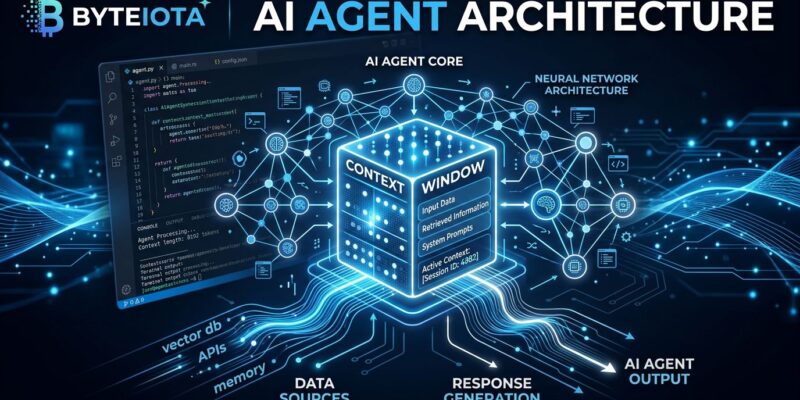
Prompt engineering and context engineering sound related. They’re not the same discipline. Prompt engineering is about the words you choose for your instruction. Context engineering is about everything the model sees — the system prompt, retrieved documents, conversation history, tool definitions, long-term memory between sessions, and current task state. One is a craft. The other is systems engineering.
Anthropic’s engineers put the problem plainly in their context engineering guide: “Bloated, poorly structured, or irrelevant information reaching the model is the silent killer of agent reliability.” The question driving context engineering isn’t “how do I phrase this?” — it’s “what configuration of context is most likely to produce the behavior I need?” That reframe changes everything about how you build agents.
By 2026, 82% of engineering leaders say prompt engineering alone is no longer sufficient to scale AI systems. When you’re operating at the level of multi-step agents working across large codebases for hours, the bottleneck isn’t vocabulary. It’s what’s in the window.
The Two-Pass Pipeline
The core architecture for production agents is a two-pass context assembly process. Anthropic and Redis engineering teams both document this pattern:
Pass 1 — Static context. System instructions, agent identity, your top 3–5 tool schemas, governance rules, coding conventions. These go at the front of the prompt and stay stable across requests. Stable prefixes enable prefix caching — unchanged segments get reused instead of recomputed on every call, cutting both latency and cost.
Pass 2 — Dynamic context. Current task state, fresh retrieval results, recent tool outputs, task-specific documents. Assembled fresh per request, kept minimal. This goes at the end.
The ordering matters because of the “lost in the middle” problem: model performance is highest when signal appears at the beginning or end of context and degrades when key information is buried in the middle of a long prompt. If you’re feeding an agent a 30,000-token context window and putting your most important instructions in the middle, you are actively making your agent worse. Put high-signal material at the top or the bottom. Never bury it.
Stop Loading Every Tool Upfront
One of the most expensive mistakes teams make is loading their entire tool library at agent startup. Loading 280 or more tool schemas can consume 70,000 tokens or more before the agent processes a single line of task description — on every call. In a long-running agent making hundreds of calls, that context overhead becomes a margin problem.
The fix is dynamic tool discovery. Anthropic’s guidance: keep your 3–5 most-used tools always loaded. For larger tool sets, use a deferred discovery model — the agent gets a search primitive at startup, fetches tool references on demand, and only those get expanded into full schemas in the active context. Cursor reported a 46.9% token reduction by switching to selective MCP tool loading on their production coding agents.
The Failure Modes Nobody Talks About
Context rot happens when old tool outputs, resolved errors, and outdated decisions accumulate in the prompt across a long agent session. They consume tokens without contributing signal. In a session running for hours, they’re the slow accumulation that eventually tips an otherwise well-functioning agent into failure.
Context poisoning is worse: an earlier model mistake stays in history and gets treated as ground truth. Later reasoning builds on the wrong foundation. Compounding errors follow. Multi-agent systems amplify both problems — if a root agent passes its full history to a subagent, and the subagent does the same, you get context explosion that no individual agent design anticipated.
The common response to agent failures is to add more context — more rules, more history, more constraints. This makes things worse. Every token competes for the model’s finite attention budget. When context grows past what’s needed, precision drops and reasoning weakens. The discipline of context engineering is knowing what to leave out.
Start with AGENTS.md
The fastest practical entry point is maintaining an AGENTS.md file in your project. By June 2026, it’s read natively at startup by Claude Code, OpenAI Codex CLI, Cursor, Aider, Devin, GitHub Copilot, Gemini CLI, Windsurf, and Amazon Q. It acts as stable static context injected automatically — coding conventions, architecture decisions, testing requirements, deployment patterns — without you having to re-explain your project on every session.
Teams with well-maintained AGENTS.md files are the ones showing up in the 55%/40% improvement numbers from Anthropic’s report. It’s not magic. It’s deliberate context design that removes the need for the agent to rediscover what it already should know.
What This Looks Like at Scale
Rakuten’s engineering team used Claude Code on a real test: implement a complex activation vector extraction method in the vLLM open-source codebase — 12.5 million lines across Python, C++, and CUDA. The agent worked autonomously for seven hours. It delivered 99.9% numerical accuracy. The ML engineer overseeing the work, Kenta Naruse, described it plainly: “I didn’t write any code during those seven hours — I just provided occasional guidance.”
Rakuten’s broader result: time to market for new features dropped 79%, from 24 days to 5. That’s not a better model. That’s a team that learned to engineer context for sustained autonomous work.
The Takeaway
Context engineering is where prompt engineering was three years ago — the line between developers who get reliable results from AI agents and those who keep debugging the same phantom failures. The techniques aren’t exotic: a two-pass assembly pipeline, dynamic tool discovery, a maintained AGENTS.md file, and deliberate context pruning to fight rot and poisoning.
Anthropic now publishes a guide on this directly. The 2026 report frames context engineering as the load-bearing skill of the agent era. The delegation gap is real — developers use AI on 60% of their work but can fully delegate only 0–20% of tasks. Context engineering is how that gap closes.