 By ByteBot
NVIDIA’s June 2026 DGX Spark software update ships three changes that materially shift what you can run locally: automated four-node clustering via a new Cluster Assistant, a 2.6x throughput improvement on Qwen3.6-35B through NVFP4 and Multi-Token Prediction, and a streamlined NemoClaw install that takes the process from hours of manual networking to under an hour. If you own DGX Spark hardware — or have been watching the platform from the sidelines — this is the update worth acting on.
Automated Multi-Node Clustering: The Biggest Change
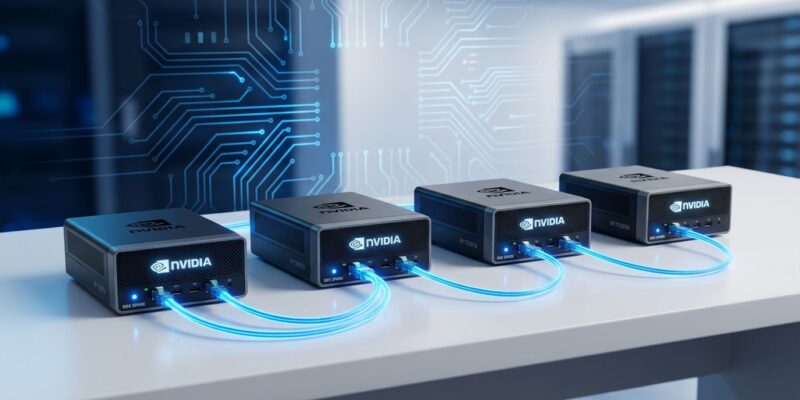
The previous barrier to running DGX Spark nodes in a cluster was not hardware — it was expertise. Configuring ConnectX-7 NICs, setting up netplan, establishing SSH trust between nodes, and getting NCCL to route correctly across 200 Gbps RoCE links required networking skills that most ML engineers simply do not have. The June update solves this with the Cluster Assistant, a new tool in the NVIDIA Sync app that automates the entire process.
The practical ceiling is now four DGX Spark units sharing 512GB of unified memory — enough to run models up to 700B parameters. Two-node setups need nothing more than a single QSFP112 DAC cable and no switch. Three-node rings work with three cables and the new NCCL 2.30u1 included in this update. Four nodes require a managed 200 Gbps-class QSFP switch.
| Configuration | Unified Memory | Max Model Size | Hardware Cost |
|---|---|---|---|
| 1x DGX Spark | 128GB | ~70B parameters | $4,699 |
| 2x DGX Spark | 256GB | ~140B parameters | ~$9,400 |
| 4x DGX Spark | 512GB | ~700B parameters | ~$18,796 |
One caveat worth stating plainly: inter-node bandwidth is 200 Gbps Ethernet, not NVLink. You get tensor parallel distributed inference — the model is split across nodes — but not the tightly coupled memory fabric of NVLink-connected server hardware. For most workloads this is fine. For latency-sensitive agent loops requiring frequent inter-layer communication, it is a real constraint. The NVIDIA developer community was unambiguous about this distinction; the hardware press was less so.
2.6x Throughput: What NVFP4 and Multi-Token Prediction Actually Deliver
NVIDIA co-developed NVFP4 quantized checkpoints for Qwen3.6-35B with the vLLM team specifically for Blackwell’s native FP4 tensor cores. Paired with Multi-Token Prediction speculative decoding, the result is a 2.6x improvement over the prior NVFP4 baseline on that model. The benchmark numbers from NVIDIA’s technical blog: 97 tokens per second on a single stream, 322 tokens per second aggregate at 8 concurrent streams with prefix-cached prefill. MTP achieves a 62–78% token acceptance rate, accepting 2.7–4.4 tokens per speculative step.
Qwen3.6-35B is a Mixture-of-Experts model with only ~3B active parameters at inference, which is why it runs efficiently at single-node scale before you even touch multi-node. Faster inference also compounds across agentic workloads: if your agent calls the model hundreds of times per task, 2.6x throughput roughly halves wall-clock time per task — which adds up across a day of production runs.
NemoClaw Install: Now Under an Hour
NemoClaw bundles three things: open models (Qwen3.6-35B as default), an agent harness (OpenClaw or Hermes Agent), and the OpenShell runtime — a sandboxed execution environment with policy-based guardrails that controls what agents can access and prevents sensitive data from leaving the device. The June 2026 installer adds an express mode: accept the third-party software notice, choose express install, and NemoClaw configures managed vLLM with the NVFP4 model automatically. The full install process is documented in the NemoClaw GitHub repo.
The honest assessment: NemoClaw is still alpha. It is not production-grade orchestration infrastructure. The install is cleaner, but teams running regulated workloads at scale will need to harden it before relying on it in production. The OpenShell security model is sound in concept — on-device, policy-controlled, nothing exfiltrating — but the implementation is early.
Why Developers Are Going Local Right Now
The timing of this update aligns with a real shift in developer economics. GitHub Copilot moved to token billing on June 1. Anthropic paused its Claude Agent SDK billing change, but the underlying uncertainty has not gone away — subscription-subsidized agent loops will eventually end. Cloud inference costs are moving from flat-rate to consumption pricing across the board.
For teams where data sovereignty is not optional — healthcare, legal, financial services — the calculus is different from pure cost. NemoClaw’s OpenShell keeps all inference on-device. No API calls, no data leaving the network. According to break-even analysis from Clanker Cloud, a single DGX Spark at $4,699 shared across three developers breaks even against cloud API costs in roughly 97 days at moderate usage. At $250 per month in API spend, payback takes about 16 months. Hardware only wins if utilization stays above 60%.
Who Should Buy This — And Who Should Wait
The DGX Spark earns its $4,699 price in one specific scenario: you need CUDA compatibility, your code must run unchanged from desktop prototype to NVIDIA datacenter deployment, or you are in a regulated industry where cloud inference is prohibited. This update substantially increases the platform’s value for that use case — you can now run frontier-scale models locally without expert networking overhead.
If you just want local inference and do not need CUDA, AMD’s Strix Halo mini PCs — the GMKtec EVO-X2 at $1,735 with 128GB unified memory and 273 GB/s bandwidth — deliver comparable or faster inference at less than half the price, with ROCm and Ollama handling the stack. See LLMRequirements for detailed benchmark comparisons.
One more consideration: NVIDIA announced the RTX Spark Superchip for laptops at Computex 2026, targeting H2 2026 with Microsoft’s Surface RTX Spark Dev Box as the reference design. Pricing has not been confirmed, but it will be lower than the desktop unit. If your timeline allows, waiting for the laptop form factor may make sense.
The June update is a meaningful incremental improvement to a platform that was genuinely difficult to configure. Removing the expertise barrier to four-node clustering is practically significant. Just don’t call it a revolution.