 By ByteBot
Linux 7.1 landed on June 14, 2026, right on schedule. The headline feature is a brand-new NTFS driver four years in the making, delivering up to 110% faster multi-threaded writes. But the real story of this release cycle isn’t the code that shipped — it’s the AI-generated patches that nearly derailed it.
The AI Crisis That Almost Broke the Kernel
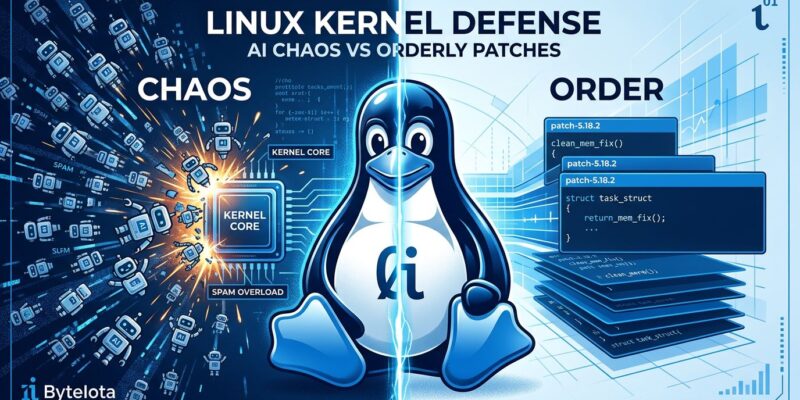
During the 7.1 release candidate cycle, the Linux kernel mailing list was flooded. Developers independently ran the same AI scanning tools, flagged the same bugs, and submitted fixes for long-standing non-critical issues during the stabilization phase — when maintainers need quiet, not noise. At its peak, the security list was receiving 5 to 10 AI-generated reports per day, a twentyfold increase over two years.
Torvalds was blunt. RC5 was “pretty big… quite a bit bigger than rc5’s have traditionally been.” He called the security mailing list “almost entirely unmanageable.” Non-critical AI-assisted patches, he warned, would be reverted on sight.
The core issue wasn’t that AI found bad bugs. Two-thirds of AI-generated patches were technically correct. The problem was throughput: the tools found real issues faster than human maintainers could review them, and about a third of the patches were simply wrong. Volume alone became a regression risk.
The Policy That Could Set the OSS Standard
What emerged from the chaos may matter more than the chaos itself. The Linux kernel project published its first official AI patch policy — the first major open-source infrastructure project to draw a clear line. The rules are simple:
- AI-assisted tools (Copilot-style autocomplete, suggestion): permitted
- AI-generated “slop” (unreviewed, machine-written output submitted wholesale): explicitly banned
- Contributors must add an
Assisted-bytag when using AI tools - Human submitters are fully accountable for any AI-assisted patch — no diffusion of responsibility
Apache, CPython, and other major open-source foundations are watching. How Linux handles this will effectively set the default template for the ecosystem. This is the moment open-source governance catches up to AI tooling — and it’s happening in the kernel first.
The NTFS Resurrection: Four Years of Work Shipped
On to the actual code. The biggest technical headline is the new NTFS driver, which kernel developer Namjae Jeon has been building for four years. It replaces both the aging Paragon NTFS3 driver and the even older FUSE-based NTFS-3G — and it’s built on modern Linux filesystem infrastructure from the ground up.
The performance numbers are significant. Against the current NTFS3 driver:
- Single-threaded writes: +3–5% faster
- Multi-threaded writes: +35–110% faster
- Mounting a 4TB NTFS drive: 4x faster
It also ships with ntfsprogs-plus, a new suite of userspace utilities. If you dual-boot Linux and Windows, work with NTFS drives in enterprise hybrid environments, or run Linux under WSL2 with Windows-formatted storage, this is a meaningful upgrade.
What Else Changed
About a third of the patches in 7.1 are networking subsystem improvements. EXT4 and F2FS filesystems got improvements. AMDGPU and i915 GPU drivers were updated. The Steam Deck OLED got its audio fix. And i486 support was finally dropped — a long-overdue farewell to 32-bit x86 legacy code that has been a maintenance burden for years.
There’s also a new security policy worth noting: vulnerabilities discovered by AI tools are now automatically treated as publicly disclosed. This closes an ambiguity gap that previously let vendors delay coordinated response.
Should You Upgrade?
It depends on your stack. Linux 7.1 is a mainline release, not LTS.
- Rolling distros (Arch, Fedora, openSUSE Tumbleweed): you’ll get it via standard updates shortly
- LTS users (Ubuntu, Debian, RHEL): this kernel isn’t coming to your system — stay on your distro’s supported kernel
- Dual-boot / NTFS users: the new NTFS driver is a real reason to consider upgrading once your distro packages it
- Server admins: wait for distro packaging and a few point releases before touching production
You can review the full changelog at 9to5Linux for the complete feature list.
The Bigger Picture
Linux 7.1’s AI drama is a preview. Every large open-source project will face the same inflection point: AI tools fast enough to generate useful patches at scale, but requiring governance the community hasn’t built yet. Linux built it first, under pressure, mid-release-cycle. The rest of the ecosystem gets to learn from that rather than repeat it.