 By ByteBot
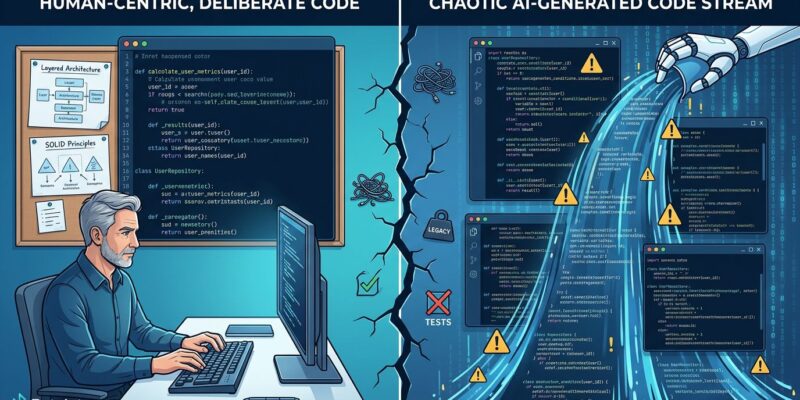
The AI productivity story always starts the same way. Output doubles. PRs ship daily. Everyone feels like a genius. Then, six months later, a senior engineer stares at a codebase that looks like it was written by a hundred different people — because structurally, it was. The AI rockstar problem is not new. It is the oldest failure mode in software engineering, wearing a very convincing new costume.
Meet Your New Rockstar
Before AI coding tools, most engineering teams had dealt with at least one rockstar developer. Brilliant, fast, working at all hours — leaving behind code that only they could understand. Half in a language nobody else used. Half dependent on libraries nobody had heard of. When they left, the whole system collapsed.
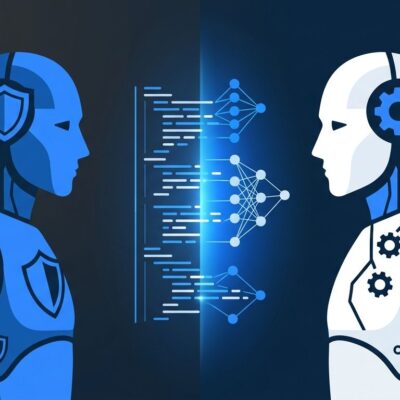
Jesse Skinner put it plainly in a piece that hit the Hacker News front page this week: AI coding agents replicate this exact structure. They generate thousands of lines of code per session, optimized entirely for task completion — not for the human who has to maintain it next month. And unlike a rockstar developer who at least remembers yesterday’s code, each new AI session starts with zero context. Every chat is a fresh rockstar joining your team, staying for an hour, and leaving you to figure out what they built.
The compounding effect is the real danger. Code becomes so complex that, as Skinner notes, “the only way to make sense of it is to use an LLM.” Which means your team is now dependent on the thing that created the problem to decode it. That is not a productivity gain. That is a trap.
The Numbers Make Denial Hard
This is not anecdotal. A 2026 study analyzing 302,000 commits across 6,299 repositories found that between 15% and 29% of commits from AI coding tools introduce at least one issue. By February 2026, over 100,000 AI-introduced issues remained unresolved in analyzed codebases. Issues introduced nine or more months ago are still sitting there — 4,893 of them specifically.
The review burden tells an even sharper story. Under high AI adoption, median time in PR review is up 441.5%. Developers now spend 11.4 hours per week reviewing AI-generated code versus 9.8 hours writing new code. The tool designed to free up developer time has flipped the equation. Bugs per PR are up 54%. Test coverage in AI-heavy projects averages 12%, versus 68% in traditionally developed codebases.
The trend that should concern every engineering leader: refactoring as a percentage of all code changes dropped from 25% in 2021 to under 10% in 2024 — a 60% decline. Teams are not cleaning up. They are moving forward and leaving the mess behind.
Gartner Is Not Being Subtle
In June 2025, Gartner predicted that over 40% of agentic AI projects will be cancelled by end of 2027 due to escalating costs, unclear business value, and inadequate risk controls. A separate projection puts 40% of AI-coded projects on track for cancellation or major rework by 2028 — specifically because of accumulated technical debt. Maintenance costs in vibe-coded projects balloon 300% within the first 18 months.
The word “silently” matters here. Technical debt compounds quietly. One messy codebase does not immediately break anything. Then three do. Then the senior engineers who understand the systems start leaving, and suddenly a feature that would have taken a week now takes three months.
Who Actually Pays the Price
A developer in the Stack Overflow blog on AI and technical debt said it well: “I used to be a craftsman. Now I feel like a factory manager of Ikea.” The Qodo State of AI Code Quality report found that 61% of developers say AI produces code that looks correct but is unreliable. Catching that unreliability falls on senior engineers, who are already spending 20 to 35% more time on code review than before AI tools became standard.
The promise sold to management — that AI would free senior developers for harder problems — has, in many organizations, produced the opposite. Senior engineers are increasingly consumed by reviewing what junior developers and AI agents generated, catching the roughly 1-in-5 AI suggestions that contain factual errors before they reach production.
The Fix Is Not a Tool Ban
The point here is not that AI coding tools are bad. The point is that most teams are using them badly.
The teams avoiding the rockstar trap in 2026 are doing a few specific things differently. They treat AI as a draft-writer, not an architect. They guide it to generate small, reviewable snippets rather than asking it to build entire features autonomously. They apply the same code review rigor to AI output that they would to a junior developer’s pull request — because that is exactly what it is. They budget time for refactoring the same way they budget time for testing, because the cleanup bill arrives eventually and is always larger than expected.
Skinner’s prescription is direct: simplify until the architecture matches the complexity of the problem. That is not an anti-AI position. It is sound engineering practice that AI adoption pressure has caused many teams to abandon.
CodeRabbit describes 2026 as the year of AI quality — companies are now formally tracking AI-attributed defect metrics, implementing multi-agent review workflows, and establishing governance policies. The teams that started that shift in 2025 are ahead. The ones that haven’t started yet are paying interest on their debt right now.
The rockstar developer problem had a known solution: set engineering standards before you hire the rockstar, not after the damage is done. The same logic applies here. Build the governance in now. Gartner’s 40% will find out what it costs to ignore it — and for most of them, that discovery will arrive too late.