 By ByteBot
Fifteen million apps. Two hundred thousand new ones per day. Built not by developers, but by anyone with a text prompt and a phone. Sekai, the AI-powered mobile platform that turns plain-language descriptions into interactive mini-apps, just raised $26 million across a seed round and Series A led by Khosla Ventures and Connect Ventures. The funding is the headline. The behavior is the story.
What Sekai Is — and Why It’s Different From Every Other AI Coding Tool
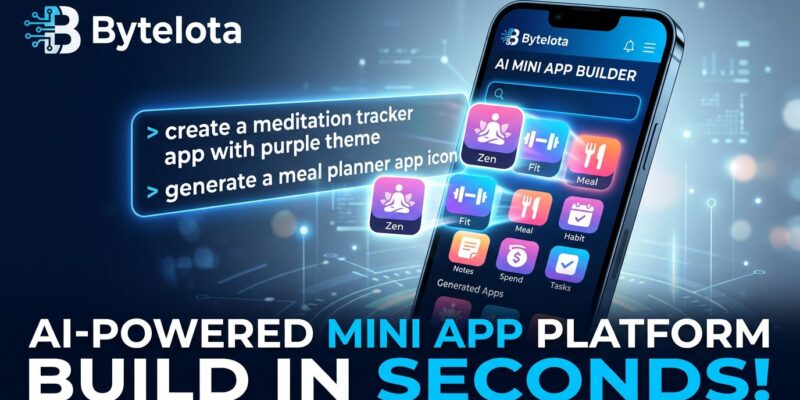
Sekai is available on iOS and Android. A user types something like “make a trivia quiz about 90s hip hop” and the platform’s AI agents build a fully playable interactive app in seconds — no code, no configuration, no deployment. Users can also remix any existing app: swap the theme, tweak the rules, publish a new version. It’s software creation with the mechanics of social content.
That last part matters. Every major vibe-coding tool on the market — Cursor, GitHub Copilot, Claude Code, Vercel’s v0 — was designed for developers. The interface assumes you understand what a codebase is. Sekai was built from scratch for people who don’t. It’s the first mainstream consumer surface where creating software is as frictionless as posting a video.
The Numbers That Reframe This as a Behavioral Story
Fifteen million apps in roughly 18 months of operation. Two hundred thousand new apps created every single day. And a reported 60-plus minutes of daily engagement per user — more than double Instagram’s average session time. These aren’t passive consumers scrolling a feed. They’re people building things and sharing them.
For comparison: Apple approves roughly 100,000 to 130,000 new apps to its App Store per month. Sekai’s users are creating nearly double that volume every day. The apps are smaller and sandboxed — mini-apps, not full production software — but the volume signals a genuine shift in who “builds software” means in 2026.
The Founder’s Thesis, Built Over a Decade
Lucky Zhang, Sekai’s CEO, is on his fourth startup. He previously sold a video commerce company to Apple and a Latin America short-video platform to ByteDance. He’s a former Google engineer who has spent, by his own account, a decade studying how content formats evolve from professional tools into social entertainment. Video editing was once a professional skill; TikTok made it a consumer behavior. Zhang believes app creation follows the same arc.
Khosla’s Keith Rabois backed the thesis: “Sekai has what most consumer startups lack: a distinct format, exceptional product velocity, and a founder who has already shipped at scale.” Connect Ventures’ Nicole Quinn added that the engagement numbers — an hour per day, 15 million created apps — represent exactly the kind of early behavioral signal investors look for before a format becomes a platform.
What This Means if You Build Software for a Living
The honest take: the floor of “building an app” has dropped to zero technical barrier. In early 2025, vibe coding was a developer trick — a way to move faster by dictating intent instead of writing boilerplate. By mid-2026, consumers are doing it 200,000 times a day without knowing the term exists. That’s not an incremental shift; it’s a change in who the builder population is.
The developer’s role doesn’t disappear in this world — it moves up. Architecture decisions, security review of AI-generated output, quality governance, and knowing when an abstraction is hiding a catastrophic assumption become more valuable, not less. Gartner has already flagged the risk: prompt-to-app approaches by non-developers are projected to increase software defects 2,500% by 2028 without proper governance frameworks. Someone has to build those frameworks.
The vibe-coding market is estimated at $4.7 billion in 2026 with a 38% compound annual growth rate. The same week Sekai announced its raise, Supabase closed a $500 million round at a $10.5 billion valuation — funded largely on the premise that AI is making database infrastructure accessible to non-engineers. The capital is consistent: it’s flowing to every layer of the abstraction stack above traditional development.
What to Watch
Sekai hasn’t announced a public API or developer SDK. Whether the platform opens up to builders — allowing custom AI behavior, integrations, or monetization tools for creators — will determine if it becomes infrastructure or stays a consumer app. Zhang’s history of building and selling to major platforms suggests he’s thinking beyond the product.
The mini-app format also has a natural ceiling: sandboxed experiences don’t replace production software. But 15 million of them, built in 18 months, suggests the ceiling is higher than most developers assumed six months ago. The Stack Overflow 2025 Developer Survey found 84% of developers already use AI tools daily — Sekai is evidence that the other 7 billion people are catching up, on their own terms.