 By ByteBot
Microsoft unveiled Project Polaris at Build 2026 on Tuesday — its own in-house AI coding model that will replace GPT-4 Turbo as the default engine inside GitHub Copilot starting August 2026. This is the company that poured $13 billion into OpenAI, now training a competing model to run its own flagship developer product. The OpenAI cord has been cut, quietly and deliberately.
What Project Polaris Actually Is
Polaris uses a Mixture-of-Experts architecture with sub-modules tuned for specific programming languages and frameworks. It runs on Microsoft’s custom Maia AI accelerators inside Azure — which means lower latency and lower per-inference cost compared to routing everything through OpenAI’s API. Microsoft claims it outperforms GPT-4 Turbo on HumanEval and MBPP benchmarks, with particular gains in Rust and Haskell.
The model applies chain-of-thought and tree-of-thought reasoning at inference time, targeting the multi-file refactoring tasks where current Copilot users hit walls. Pro tier subscribers get 100,000-line multi-file context and autonomous test generation — features that have been Claude Code’s competitive edge.
Alongside the model switch, Microsoft is launching the Code Content Guarantee: Polaris was trained exclusively on permissible data, and Microsoft will indemnify customers against intellectual property claims on generated code. For enterprise legal teams still skittish about AI-generated code, that’s a meaningful offer.
Why Microsoft Is Doing This Now
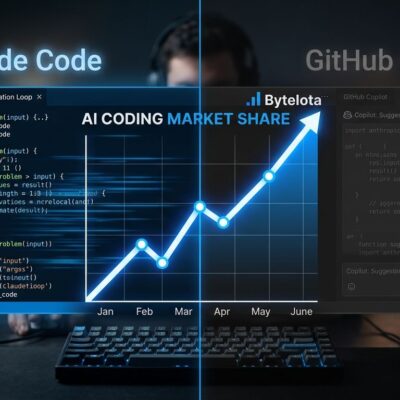
Claude Code launched in May 2025. By early 2026, it had overtaken GitHub Copilot in the agentic coding category — a market Copilot essentially invented. JetBrains’ 2026 developer survey put the damage in stark numbers: 46% of developers name Claude Code their most loved tool, compared to 9% for Copilot. Among developers who use AI agents daily, 71% prefer Claude Code.
At Build 2026, Microsoft did something unusual for an incumbent: it named Claude Code directly as the competitor it’s responding to. That’s the first time a major platform vendor has publicly acknowledged losing measurable ground to Anthropic in a specific product category. It’s an admission, and it’s also a signal that Polaris is a serious strategic bet, not a marketing story.
GitHub Copilot still leads in raw enterprise deployment — 29% of enterprise developers use it, and GitHub’s distribution across 100 million developers is irreplaceable. But “most deployed” and “most loved” are different metrics, and Microsoft knows which direction that gap is moving.
The OpenAI Tension Is Real
Microsoft invested $13 billion in OpenAI and committed $5 billion more to Anthropic. Azure is OpenAI’s exclusive cloud provider. And now Microsoft is building a model that competes directly with the company whose success it funded. The financial relationship is still in place; the strategic dependency is being dismantled.
A May 2026 analysis of Microsoft’s 10-Q showed the company has been “quietly converting its OpenAI exposure from an operating dependency into a financial position.” Fortune’s pre-Build headline asked: “Microsoft lost its way in the AI race. Can Copilot get it back?” Project Polaris is the answer Microsoft chose to give.
The underlying bet is that AI models will commoditize — and that the real value will accrue to whoever owns the developer workflow, not whoever trains the smartest model. Microsoft owns GitHub, VS Code, and Azure. Even if Polaris underperforms Claude Code on raw capability in August, Microsoft can iterate on its own infrastructure without writing OpenAI a check for every inference.
What Copilot Users Should Expect
If you’re a Copilot subscriber, August 2026 is the transition date. Migration is automatic — you don’t need to do anything. If you or your team want to stay on GPT-4 Turbo, there’s a three-month fallback window before Polaris becomes the only option.
Worth noting: Copilot Workspace also hit general availability at Build. GitHub’s agentic programming environment — which reasons across full repositories, proposes multi-file edits, runs tests, and interprets results — is now a production feature, not a research preview. Autopilot and fleet modes are included.
The honest caveat: Microsoft has not published benchmark comparisons between Polaris and Claude Code on real-world multi-file tasks. The HumanEval and MBPP numbers beat GPT-4 Turbo, but those benchmarks were not designed with agentic coding in mind. August will be the real test. Watch for community benchmarks to hit GitHub within days of rollout.
The AI Coding Wars Just Got More Interesting
Copilot launched in 2021 with GitHub’s distribution and OpenAI’s models. For three years, that combination was unbeatable. Then Claude Code showed up, moved faster in the agentic category, and won developer affection at a speed that clearly caught Microsoft off guard.
Project Polaris doesn’t guarantee Copilot gets that ground back. But it closes one vulnerability: Microsoft no longer has to ask OpenAI’s permission to improve its own product’s core model. That matters more than any single benchmark.
Next up: WWDC 2026 starts June 8. Apple is expected to announce its own AI-independent coding strategy for Xcode. The incumbents are done waiting for third-party AI labs to solve their problems for them.