 By
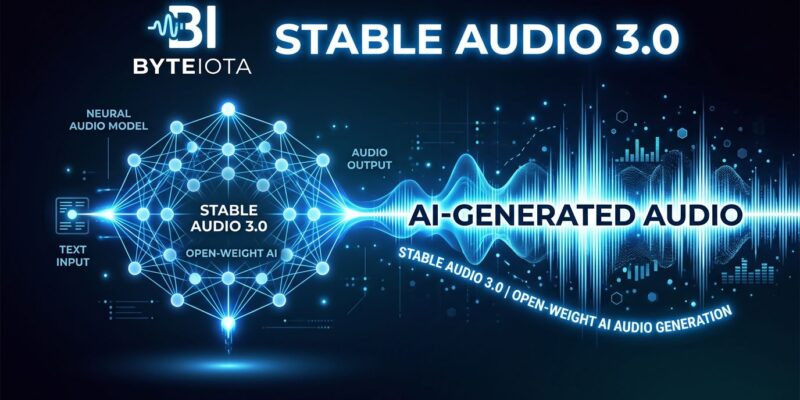
By Stable Audio 3.0 dropped nine days ago. Most coverage led with “AI can now write six-minute songs” — technically true, completely missing the point for developers. What Stability AI actually shipped on May 20 is an open-weight model family you can run locally on a CPU, fine-tune on your own dataset, and deploy in commercial products with a clear license. No API dependency. No rate limits. No ongoing per-generation costs. That’s the story worth covering.
Four Models, One Decision to Make
Stable Audio 3.0 is a family, not a single model. Here’s what shipped:
- Small SFX — 459M parameters, sound effects only, up to 2 minutes, runs on CPU
- Small Music — 459M parameters, instrumental music only, up to 2 minutes, runs on CPU
- Medium — 1.4B parameters, music and SFX combined, up to 6 minutes 20 seconds, requires CUDA GPU
- Large — 2.7B parameters, highest quality, music and SFX, API-only (no weights released yet)
For most developer use cases, the decision is easy: Small for SFX integration, Medium for music features. The CPU-compatible Small models are particularly useful — they mean you can embed audio generation into any server or edge environment without GPU provisioning overhead.
Getting Started in Five Minutes
Stable Audio 3 uses uv as its package manager. Clone the repository, sync dependencies, and you’re generating audio in a few commands:
git clone https://github.com/Stability-AI/stable-audio-3
cd stable-audio-3
uv sync                           # inference only
uv sync --extra train --extra ui  # add training + Gradio UI
To launch the local web interface:
uv run python run_gradio.py --model mediumWeights for Small and Medium are on Hugging Face. Flash Attention 2 is optional but recommended for Medium — install from the pre-built wheels repo to avoid a painful source compilation. The architecture is a Diffusion Transformer (DiT) with a semantic-acoustic encoder producing 44.1 kHz stereo latents, which is why inference is measurably faster than older Stable Audio versions even at higher quality.
LoRA Fine-Tuning: The Feature That Changes the Calculus
This is what separates Stable Audio 3 from being an interesting demo and makes it a foundation for actual products. Stability shipped LoRA training documentation on day one alongside the weights. You can fine-tune on your own audio corpus — a game studio’s existing soundtrack, a brand’s audio identity, a specific genre library — and the resulting adapter runs on top of the base model without retraining it.
Loading a LoRA checkpoint is a single flag:
uv run python run_gradio.py --model medium --lora-ckpt-path path/to/lora.ckptAdapters stack and blend at runtime. A game studio could maintain multiple LoRAs for different zones — dungeon ambience, overworld themes, boss encounters — and blend them without generating from scratch each time. The technical paper at arXiv:2605.17991 details the conditioning architecture if you want to understand what you’re actually training.
Why This Beats Suno and Udio for Developers
Suno and Udio generate compelling songs with vocals and lyrics. They’re excellent tools for end users. They are not the right choice for building a product.
| Feature | Stable Audio 3 | Suno / Udio |
|---|---|---|
| Open weights | Yes (Small, Medium) | No |
| Local deployment | Yes | No |
| LoRA fine-tuning | Yes | No |
| Vocal generation | No | Yes |
| Licensed training data | Verified | Disputed (ongoing litigation) |
| GPU requirement | None for Small | N/A (cloud only) |
The licensing point is not abstract. Suno and Udio are actively facing copyright infringement suits from major labels. Enterprise legal teams have been blocking their adoption in commercial products as a result. Stable Audio 3 was trained on AudioSparx catalog data and Creative Commons sources — and Stability AI signed direct licensing deals with Universal Music Group and Warner Music Group. That gives enterprise users and developers building commercial products an actual legal foundation to stand on.
The License Has a Cliff You Need to Know About
The Stability AI Community License covers commercial use free of charge — with one condition: your organization’s annual revenue must be under $1 million. Above that threshold, you need the Enterprise License, which requires contacting Stability AI directly and adds legal indemnification to the arrangement.
Your output files belong to you regardless of license tier. You can sell or distribute generated audio under both the community and enterprise paths. Read the full terms at stability.ai/license before shipping into production at scale.
What It Doesn’t Do
Stable Audio 3 does not generate vocals or lyrics. If you need AI-assisted song creation with sung content, Suno and Udio still own that space. The Large model weights are not available — only the API, and Stability AI has not announced a timeline for releasing them. AMD GPU support is in the roadmap but not shipping yet; NVIDIA CUDA is the practical target for the Medium model. ComfyUI integration is live on day zero for those building production audio pipelines, which is a useful signal about ecosystem priority.
The Bigger Picture
Open-weight image generation had a “SD 1.5 moment” — not the highest quality model, but the one that seeded an entire ecosystem of fine-tunes, tools, and production integrations. Stable Audio 3 is plausibly that moment for AI audio. The model quality is solid, the weights are accessible, the fine-tuning story is real, and the licensing is defensible. That combination has not existed before in this space.
If you’re building anything with audio — games, apps, creative tools, marketing automation — the five-minute setup is worth your time this week. The official repository has everything you need to start, and the ComfyUI integration guide covers the node-based workflow for more complex pipelines.