 By ByteBot
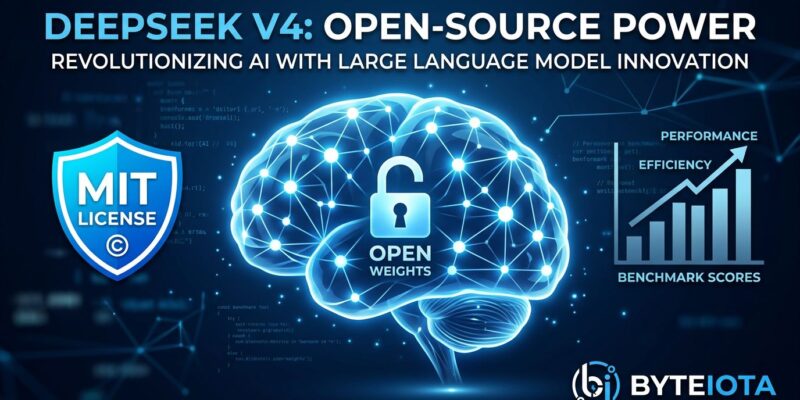
DeepSeek released V4-Pro on April 24 with an MIT license, a 1.6-trillion-parameter mixture-of-experts architecture, and a SWE-bench Verified score of 80.6% — two-tenths of a point behind Claude Opus 4.7. At $1.74 per million input tokens, it costs roughly ten times less than comparable closed frontier models. For the first time, “open weights” and “frontier-level coding performance” are not a trade-off.
The Benchmark Picture — Honest Edition
The headline number is real: on SWE-bench Verified, V4-Pro trails Opus 4.7 by a margin you would call a rounding error. GPT-5.5 lands at 74.9%, nearly six points behind. On LiveCodeBench, V4-Pro-Max scores 93.5 — the highest of any tested model so far.
The honest caveat lives in SWE-bench Pro, the harder eval with messier, more realistic bugs: V4-Pro scores around 55% while Claude Opus 4.7 hits 64.3%. That 9-point gap is not noise. For automated coding agents handling complex refactors or gnarly legacy codebases, the gap matters. For the majority of API use cases — summarization, code generation at moderate complexity, structured extraction — V4 holds its own completely.
| Model | SWE-bench Verified | SWE-bench Pro | LiveCodeBench | Input Price/M |
|---|---|---|---|---|
| DeepSeek V4-Pro | 80.6% | ~55% | 93.5 | $1.74 |
| Claude Opus 4.7 | 80.8% | 64.3% | ~88.8 | ~$15+ |
| GPT-5.5 | 74.9% | N/A | N/A | ~$15+ |
The MIT License Is the Bigger Story
The benchmark comparison grabs headlines, but the license might matter more long-term. Both V4-Pro and V4-Flash ship as MIT on Hugging Face: commercial use, fine-tuning, redistribution, no royalties. You can build a product on V4, fine-tune it on proprietary data, keep the resulting weights private, and ship commercially — all without asking DeepSeek permission or paying a licensing fee.
To be clear about what is not public: the training code, training data, and RLHF pipeline remain closed. You get the weights and architecture, not a recipe to train your own V4. That is a meaningful distinction. But for the vast majority of production use cases, MIT weights are exactly what teams have been waiting for from a frontier-class model.
The self-hosting angle follows directly: open weights on vLLM or Modular inference stack mean you are never hostage to DeepSeek API pricing, uptime, or policy decisions.
Pricing: The Math Is Hard to Ignore
V4-Flash costs $0.14 per million input tokens — the cheapest capable model currently available. V4-Pro sits at $1.74/M. For context, comparable closed frontier models run $15 or more per million input tokens. On high-volume workloads, that is not a 10% savings; it is a different order of magnitude.
DeepSeek also uses a cache-hit pricing model, which further reduces costs on repetitive or templated workloads. Teams running document processing pipelines, code review bots, or large-scale summarization will see the gap widen further in practice.
Migrating From OpenAI or Anthropic: Two Lines of Code
DeepSeek V4 API is OpenAI-compatible. The migration is two changes:
# Before (OpenAI)
client = OpenAI(api_key="sk-...")
response = client.chat.completions.create(model="gpt-4o", ...)

# After (DeepSeek V4)
client = OpenAI(
    api_key="your-deepseek-key",
    base_url="https://api.deepseek.com/v1"
)
response = client.chat.completions.create(model="deepseek-v4-pro", ...)
Tool calling, JSON mode, streaming, and function schemas all work identically to the OpenAI SDK. The reasoning_effort parameter (high or max) replaces the old deepseek-reasoner model for thinking-heavy tasks. See the DeepSeek function calling docs for the full tool schema reference.
One hard deadline: Legacy model names deepseek-chat and deepseek-reasoner are deprecated on July 24, 2026 at 15:59 UTC. No grace period, no silent fallback — calls will error. If you are using the old names anywhere in production, update them now.
The Data Privacy Tradeoff
Using DeepSeek hosted API means your prompts land on servers in China, subject to China National Intelligence Law. That is not paranoia; it is a legal reality that has already triggered bans across Italian regulators, U.S. federal agencies, and multiple state networks. DeepSeek also previously exposed a database containing over a million records — chat histories, API keys, and backend logs — with no authentication.
The mitigation is the open weights themselves. Self-host V4-Flash on your own infrastructure and the data exposure issue disappears entirely. V4-Flash runs on high-end consumer hardware; V4-Pro requires a multi-node H100 or Blackwell cluster. For teams that cannot self-host, third-party providers like Together AI and DeepInfra offer hosted inference outside Chinese jurisdiction.
When V4 Makes Sense
Use V4-Pro when you need near-frontier coding performance at a fraction of the cost and can accept the SWE-bench Pro gap. Use V4-Flash when you want the cheapest capable model available, period. Stick with Claude Opus 4.7 or GPT-5.5 for hard, multi-step reasoning tasks where the harder benchmark gap closes that price argument. And if data residency is non-negotiable, self-host or route through a non-DeepSeek provider.
The open-source AI field just got a credible frontier competitor. That changes pricing pressure on every closed lab. Whether or not V4 is the right choice for your stack, the fact that it exists at this quality tier under MIT is a meaningful shift in the landscape.