 By
By SvelteKit’s May 2026 update doesn’t announce a new major version. It opens the CLI to community add-ons, ships TypeScript 6 compatibility, and breaks a remote functions API that a good chunk of production apps are using. Three changes, different impact levels — here’s what you need to know before your next upgrade.
Community Plugins Are Now a Thing in the Svelte CLI
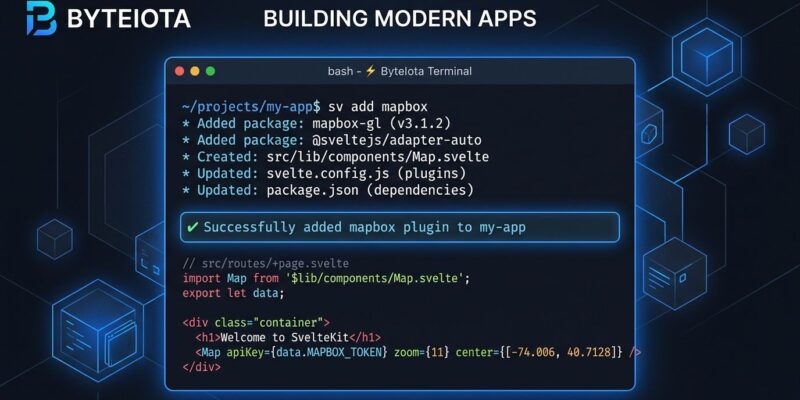
The sv CLI ships sv@0.1.0 with community add-ons as an experimental feature. Any npm package published with the keyword sv-add can now be installed with a single command:
npx sv add @your-org
npx sv add eslint @supacool       # mix official and community
npx sv add file:../my-local-addon # local development
This is the right answer to SvelteKit’s most persistent criticism. The ecosystem gap versus Next.js — fewer official integrations, less plug-and-play setup — has been the main argument against picking SvelteKit for greenfield projects. Community plugins don’t close that gap overnight, but they provide the infrastructure to do it without bloating the core.
The Svelte maintainers are being explicit about scope: the official add-on list stays curated and small. Supabase, Prisma, custom auth adapters, edge function helpers — those will live as community packages. Developers build them, publish them, and you install them with a single command. This mirrors how Go’s standard library works: the core stays lean, the ecosystem fills in the rest.
Two caveats before you ship this in production: community add-ons are experimental (the API may change), and Svelte maintainers have not reviewed community packages for malicious code. Treat them like any other third-party npm package — check the source, check the publisher, don’t blindly run them on sensitive projects. The official sv add docs list what’s reviewed and what isn’t.
Remote Functions: You Probably Need to Update Your Code
SvelteKit 2.56.1 adds a .run() method to queries and stops you from awaiting queries directly outside the render pipeline. If you’re using remote function queries in event listeners, onMount, or standalone .svelte.ts files, this breaks existing code:
// Before (2.55.x)
const result = await myQuery();

// After (2.56.1+) — outside render pipeline
const result = await myQuery.run();
There’s a trap that didn’t make it into the changelog: using .run() requires async Svelte to be enabled. If you upgrade and start seeing “async Svelte required” errors, that’s why. Enable it in your Svelte config before shipping the fix. Check the full SvelteKit changelog for the exact config flag.
The same 2.56.0 release changes the transport layer for queries to use hydratable, powered by devalue. You can now return Map, Set, URL, and BigInt values directly from remote function queries without manual serialization. If you were flattening these types to plain objects before returning them, you can stop. It’s a quiet improvement that removes a real class of type-mismatch bugs.
TypeScript 6 Compatibility and Form Changes
SvelteKit 2.56.0 is compatible with TypeScript 6.0, which matters for anyone upgrading their TypeScript version at the same time. TypeScript 6 ships with strict: true as the new default, removes legacy module modes (amd, umd, systemjs), and changes default moduleResolution. Upgrade SvelteKit to 2.56.0 first, then touch your tsconfig.json.
SvelteKit 2.57.0 also tidies up enhanced form remote functions: form submit now returns a boolean — true for valid, false for invalid — instead of requiring you to inspect a raw ActionResult. It’s minor but practical for form validation flows where you want conditional error UI without writing a type guard.
The Bigger Picture
SvelteKit has 93% developer satisfaction in 2026 — the highest of any full-stack JavaScript framework — but 500K weekly downloads against Next.js’s 6.5 million. That gap is ecosystem inertia, not a technical argument. Developers reach for Next.js because the integrations are pre-built and the hire pool is deep.
Community plugins attack the integration problem directly. If the community ships high-quality sv add packages for the common cases — database clients, auth providers, deployment adapters — SvelteKit stops losing evaluations on “but what about X?” The remote functions story is separate: SvelteKit’s native answer to tRPC is genuinely better for most CRUD applications — no separate router config, no client setup, end-to-end types without ceremony. The May updates make that story stronger by removing the type limitations on what you can return.
To upgrade: run npm update @sveltejs/kit or bun upgrade @sveltejs/kit, audit any query usage outside the render pipeline for the .run() change, and read the official May 2026 update post on the Svelte blog for the full list of fixes. The remote functions documentation covers the new transport model in detail.