 By ByteBot
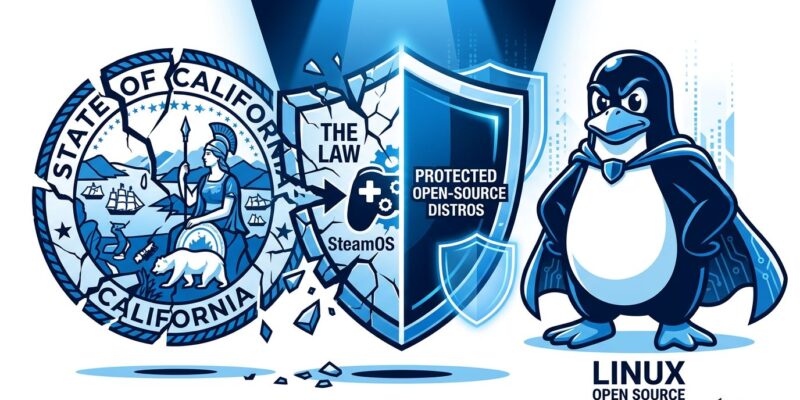
California moved this week to exempt most Linux distributions from its controversial age-verification law — and the amendment was written by the same lawmaker who created the problem in the first place. Assembly Bill 1856, updated May 18 and sent to third reading on May 19, carves out any operating system distributed under open-source license terms that permit copying, redistribution, and modification. Debian, Ubuntu, Fedora, Arch Linux, and Linux Mint are almost certainly safe. SteamOS, however, is not.
What California’s Age Verification Law Actually Demands
The original law, AB 1043 (the Digital Age Assurance Act), passed in late 2025 and kicks in January 1, 2027. It requires every “operating system provider” to collect users’ birth dates during device setup and maintain a real-time API that returns one of four age brackets — under 13, 13-15, 16-17, and 18 or older — on request from any app or app store. The intent was to prevent minors from accessing age-inappropriate content. The execution assumed every OS has a corporate owner with a legal team and a centralized account system.
Linux distributions have none of those things. Most are volunteer-maintained, ship with no user account infrastructure, and generate no revenue. Fedora proposed a pragmatic workaround: store age in a local file at /etc/ and serve it via a local D-Bus interface with no telemetry, no servers, no central database. Artix Linux’s developer was blunter: “We’ll NEVER require any verification or identification from the user.” The Electronic Frontier Foundation put it plainly: “A.B. 1043’s burdens fall particularly heavily on developers who aren’t at large, well-resourced companies, such as those developing open-source software.”
What AB 1856 Changes — and Why the Language Matters
AB 1856 does not repeal AB 1043. Instead, it narrows the definition of “operating system provider” to exclude any entity distributing an OS under license terms that let users “copy, redistribute, and modify the software.” That is the core test. Permissive open-source license equals exempt. Proprietary licensing or bundled closed components equals subject to the law.
The practical effect is clean: Debian, Ubuntu, Fedora, Arch, Linux Mint, Pop!_OS, OpenSUSE, Elementary OS — all exempt. Windows, macOS, Android, iOS, and ChromeOS — all must comply. The exemption uses the fundamental property of open-source licensing as its dividing line rather than naming specific distros, which means it extends to any genuinely open OS without requiring further lobbying. According to Tom’s Hardware, Colorado is passing a nearly identical exemption (SB26-051) under the same license-based criteria, effective July 2028.
SteamOS Is the Exception — and the Lesson
SteamOS runs on Linux. It uses an open-source kernel and a largely open-source userspace. But SteamOS ships with Valve’s proprietary Steam client, and that bundled closed component disqualifies it from the open-source exemption. The Steam Deck, Steam Frame, and the Legion Go S — all running SteamOS — remain subject to AB 1043’s age-verification requirements. GamingOnLinux confirmed that devices shipping with these proprietary layers will need to comply.
This is worth pausing on. “Linux-based” is a marketing description. “Open-source software” under a permissive license is a legal one. The two overlap heavily but not completely. SteamOS falls in the gap because Valve made a deliberate business decision to include a proprietary layer — a decision that now has regulatory consequences. It is not a design flaw in AB 1856. It is AB 1856 working exactly as intended. If a platform bundles closed software, it should not receive the same legal protections as one that doesn’t. This same dynamic has shown up elsewhere: as we covered with AMD Vivado dropping its Linux free tier, proprietary software decisions on open platforms create friction that falls squarely on users and developers.
Key Takeaways
- AB 1856 exempts any OS distributed under open-source license terms permitting copy, redistribute, and modify — this covers every major Linux distribution
- AB 1856 is still pending a California legislature vote expected in June 2026; the original AB 1043 takes effect January 1, 2027 regardless
- SteamOS does not qualify for the exemption because it bundles Valve’s proprietary Steam client — Steam Deck, Steam Frame, and Legion Go S are all affected
- A separate federal bill (H.R. 8250) remains under consideration and could supersede California’s approach entirely, adding long-term policy uncertainty
- “Linux-based” and “open-source” are not legally synonymous — and distro maintainers are paying close attention to the June vote