 By ByteBot
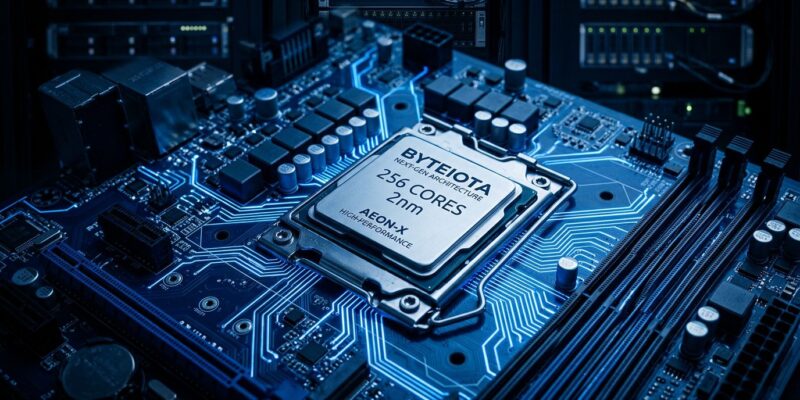
AMD entered volume production of EPYC Venice on May 20 — the world’s first server CPU built on TSMC’s 2nm process. The Zen 6-based chip delivers 256 cores, 1.6 TB/s of memory bandwidth, and a 70% performance jump over the current Turin generation. It ships in H2 2026. Intel’s direct competitor, Diamond Rapids Xeon 7, just slipped to mid-2027. That’s not a minor scheduling hiccup. That’s a 12-month window where AMD holds the only next-generation premium server CPU on the market, and data center teams need to plan around that reality now.
The Numbers That Actually Matter for AMD EPYC Venice
Venice moves the EPYC platform to a new SP7 socket with 16-channel DDR5 support, pushing per-socket memory bandwidth from Turin’s 614 GB/s to 1.6 TB/s — a 2.6x jump. PCIe 6.0 doubles CPU-to-GPU bandwidth. Core count tops out at 256 Zen 6 cores, up from Turin’s 192. According to Tom’s Hardware’s deep-dive on the production announcement, AMD claims more than 70% overall performance improvement and 30% better thread density versus the 5th Gen platform.
However, the 1.6 TB/s figure is the one to focus on if your team runs AI workloads. LLM inference is memory-bandwidth-bound, not compute-bound, on the CPU side. Moving context windows between host and GPU accelerator is where bandwidth gets spent. Venice’s memory subsystem was designed with this bottleneck in mind — AMD explicitly built the platform for what it’s calling “agentic AI leadership.” As we covered in our analysis of AI chip memory costs in 2026, bandwidth is increasingly where the bottleneck lives.
Why the CPU Is Making a Comeback
For the past three years, every data center conversation has centered on GPUs. Blackwell, H100, MI300X — the GPU gets the headlines and the budget. The CPU became an afterthought. That framing was always incomplete, and at scale, it breaks down entirely.
In a modern AI cluster, the GPU runs inference. The CPU runs everything else: workload orchestration, memory and data movement, networking, storage coordination, and the enterprise applications running alongside production models. As GPU clusters scale to hundreds or thousands of accelerators, the CPU managing that cluster becomes a throughput constraint. A bottlenecked CPU means underutilized GPUs — which at $40K per B200 card, is an expensive problem.
Venice addresses this directly. The 256-core, PCIe 6.0, 1.6 TB/s platform is not a general-purpose enterprise upgrade. It’s a high-density orchestration engine for AI infrastructure. AMD’s follow-on chip “Verano” makes this even clearer — it adds LPDDR support and is explicitly positioned as the agentic AI variant of Venice. The ServeTheHome analysis confirms the thread density improvements alone represent a generational shift for dense server deployments.
Intel’s Missing Year
Diamond Rapids was supposed to arrive in 2026. It won’t. According to Tom’s Hardware’s reporting on the Diamond Rapids delay, Intel’s next-generation Xeon 7 now lands in mid-2027. When it does arrive, Diamond Rapids will offer comparable specs — 192 Panther Cove-X P-cores, 16-channel memory, 1.6 TB/s bandwidth. But that’s 2027.
Intel’s 2026 server option is Clearwater Forest, an E-core design on Intel 18A. It’s optimized for density in hyperscale deployments, not high-performance general compute. Furthermore, it’s not a substitute for data center teams looking at premium workload servers. Intel has no response to Venice in the high-performance server segment for the entirety of 2026.
This matters because enterprise hardware refresh cycles run three to five years. Teams buying server infrastructure in H2 2026 are locking in platforms well into the late 2020s. AMD is the only vendor offering a next-generation, high-performance server CPU this year. That competitive gap has real implications for market share — and for the installed base Intel will be working to reclaim after Diamond Rapids finally ships.
The Power Problem Doesn’t Disappear
Venice is not a clean upgrade story for everyone. The high-frequency 256-core variant can pull up to 1,400W. Even the efficiency-tuned Zen 6C variant runs 350–400W. Air cooling is insufficient for high-TDP SKUs — liquid cooling with custom cold plates is required. Additionally, Venice ships on the new SP7 platform, which means new motherboards. If you’re running Turin-based SP5 systems, this is not a drop-in upgrade. The SP7 platform specification details make clear how extensive the infrastructure changes are.
The SP7 packaging also requires new rack power delivery planning. Data centers that haven’t upgraded their power infrastructure for liquid-cooled, high-density compute will face capex beyond the chip price. This is the honest constraint that vendor marketing glosses over: Venice is powerful, but unlocking that power has prerequisites most existing deployments don’t meet out of the box.
What Infrastructure Teams Should Do Now
If you’re speccing new server builds for H2 2026, Venice belongs in the conversation. It’s the most capable server CPU shipping this year, and there’s no Intel equivalent arriving before 2027. Cloud teams should watch for Venice-based instances from AWS, Azure, and Google Cloud — none have announced specific timelines yet, but hyperscaler deployment typically follows production availability by six to nine months.
If your team is committed to Intel-based infrastructure, Granite Rapids Xeon is the ceiling for 2026. Don’t budget around Diamond Rapids this year — it’s not coming. Moreover, if your AI inference pipeline runs CPU-side operations at scale, the 1.6 TB/s memory bandwidth on Venice changes the math on what’s worth optimizing. The CPU is no longer just the glue holding your GPU cluster together. On Venice, it’s a first-class participant in the workload.