 By
By AI agents are already browsing the web — they’re just doing it badly. The current approach involves taking a screenshot, asking a model to guess where the button is, clicking, waiting, and screenshotting again. It’s fragile, expensive, and breaks whenever a CSS class changes. Google’s WebMCP, announced at I/O 2026 and now in public origin trial with Chrome 149, replaces that loop with something that actually works: a browser-native standard that lets any website expose structured, callable tools directly to AI agents. Six major platforms — Booking.com, Expedia, Instacart, Intuit, Shopify, and Redfin — have already committed to implementing it. Most developers haven’t noticed yet.
What WebMCP Is
WebMCP stands for Web Model Context Protocol. It’s a proposed open standard developed jointly by Google and Microsoft through the W3C Web Machine Learning Working Group. Where the original Model Context Protocol (MCP) connects AI agents to backend servers via JSON-RPC, WebMCP is browser-native — tools live in the page’s JavaScript context, share the user’s existing session, and execute directly in the active tab. No backend changes required for the basic case. No separate API to authenticate against. The browser mediates what the agent can do.
Think of it as giving websites an official API surface for AI agents. Instead of an agent squinting at a screenshot trying to find your checkout button, it calls checkout({ cartId, paymentMethod }) and gets back structured JSON.
Two APIs, Minimal Friction
WebMCP ships with two implementation paths, and the simpler one requires almost no code.
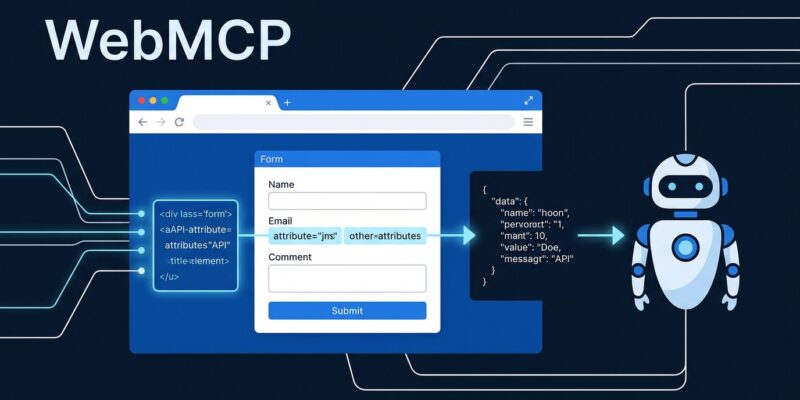
The Declarative API works by annotating existing HTML forms with two attributes: toolname and tooldescription. The browser generates the JSON schema automatically from the existing form structure. Here’s what that looks like in practice:
<form toolname="bookFlight"
      tooldescription="Search and book available flights">
  <input name="origin" toolparamdescription="Departure airport code (e.g. SFO)">
  <input name="destination" toolparamdescription="Arrival airport code">
  <input name="date" type="date" toolparamdescription="Travel date">
  <button type="submit">Search</button>
</form>
That’s a complete WebMCP tool. No JavaScript. No backend. If your site uses standard HTML forms, you can make them agent-callable this week.
The Imperative API gives you full programmatic control via navigator.modelContext.register(). This is for complex workflows — multi-step checkout, dynamic state management, anything that can’t be expressed with a single form submission. Both approaches work today via Chrome’s chrome://flags menu, with the Chrome 149 origin trial now open for production traffic registration.
Why Six Companies Pre-Committing Is the Real Signal
Companies don’t commit to implementing unfinished standards out of altruism. Booking.com, Expedia, Instacart, Intuit, Shopify, and Redfin all signed on publicly at I/O 2026 because they believe agent-driven traffic is coming fast and they want first-mover advantage. This is the same logic that drove early schema.org adoption — not because structured data was finalized, but because search engines were already rewarding it.
The relevant analogy is robots.txt: created in 1994, ignored for years, then quietly became existential infrastructure once search crawler volume reached a threshold. WebMCP is on the same trajectory — except AI agent traffic compounds faster than search crawlers ever did. If an agent can’t complete a task on your site because you haven’t implemented WebMCP, it won’t retry. It’ll go somewhere that has.
What to Do Right Now
For developers who want to get ahead of this: start with the Chrome for Developers WebMCP documentation, register for the Chrome 149 origin trial, and test locally by enabling the WebMCP flag at chrome://flags. The declarative path is the fastest starting point — audit your existing HTML forms, add the two attributes, and you have agent-callable tools with zero backend changes.
If you’re building a new feature and it involves a form or a structured action flow, design it as a WebMCP tool from the start. The overhead is negligible and the forward compatibility is real.
The Catches
WebMCP works in Chrome 149+ and Microsoft Edge 147+. Firefox is tracking an implementation but hasn’t shipped — estimates put it 8-12 weeks out. Safari has no committed timeline. Apple has representatives in the W3C working group, but “participating” is not “shipping.” Safari holds over a third of mobile web traffic, and if Apple doesn’t implement, WebMCP has a significant coverage gap on mobile.
There’s also a security issue that Google hasn’t fully closed: WebMCP tools execute with the user’s existing browser session. There’s no separate credential the agent uses — it inherits whatever the user is logged into. Security teams can’t audit or revoke agent access independently. Prompt injection remains a live concern — a malicious page could potentially manipulate an agent’s tool calls through crafted descriptions. Google’s position is that the browser is the security perimeter. That’s defensible, but it’s not a complete answer.
Tools also require an active, open browser tab. Headless operation isn’t supported, which limits background automation use cases.
The Bottom Line
WebMCP was arguably the most significant announcement at I/O 2026 that got buried under Gemini demos and Antigravity 2.0 coverage. It’s infrastructure, and infrastructure announcements don’t trend. But infrastructure determines which sites agents can use effectively and which they can’t. The declarative API has essentially no implementation cost if your HTML is already clean. There’s no good reason to wait.