 By ByteBot
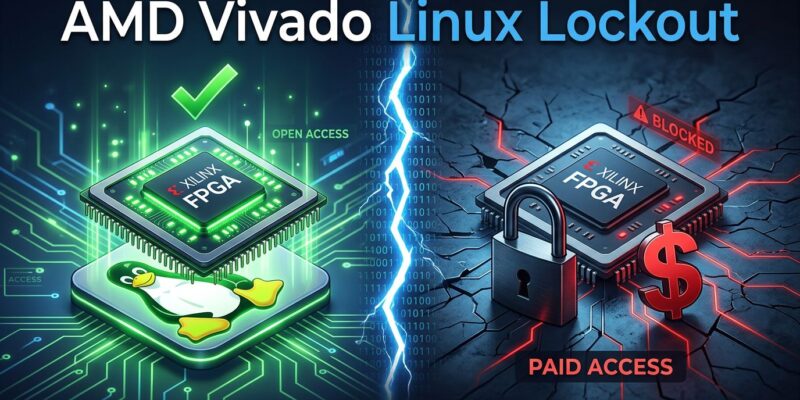
AMD has quietly removed Linux support from the free tier of Vivado, its flagship FPGA development suite. Starting with Vivado 2026.1, Linux developers who want to stay current must either pay $1,200 or more per year for the Standard Edition or do their FPGA work on Windows. The developer community, predictably, is not taking this quietly.
What Actually Changed
Vivado 2026.1 introduces a restructured licensing model with new tiers and pricing options. The headline change: the free Basic tier now only runs on Windows. Linux support has been moved up to the paid Standard Edition, starting at around $1,200 per year.
AMD is providing one lifeline: existing licenses for Vivado 2025.2 remain valid indefinitely, so users who install the current version now can keep using it on Linux — at least until it stops receiving updates. Whether AMD will keep the 2025.2 installer available after 2026.1 ships is an open question.
The company’s justification, offered by AMD engineer Anatoli Curran in the company’s own support forums: “Almost all our surveys show… close to 70% of the customers are still using Windows.”
Who Gets Hurt — And Why It Matters
There is a critical distinction AMD appears to be missing. That 70% Windows figure describes paying enterprise customers. The free tier is not where enterprise customers live.
The people who use Vivado’s free tier are students in university computer architecture labs, hobbyists building FPGA-based retro computers and software-defined radio setups, researchers doing mixed software-hardware work on Linux servers, embedded systems developers building Linux-native SoC products, and EU developers whose organizations are actively migrating away from Windows for compliance and security reasons.
These are not people who can absorb a $1,200 annual tool license. They are also precisely the community that feeds AMD’s future enterprise pipeline. The student doing FPGA coursework on Linux today is the ASIC engineer signing off on an AMD Alveo order in five years.
The Reaction Is What You’d Expect
Multiple Hacker News threads erupted within days of the announcement. Slashdot covered it on May 23. The AMD support forum where Curran responded accumulated pointed pushback. The consensus is blunt: companies that support Linux earn broader developer loyalty — including for paid products — and companies that don’t lose it across the board.
Several developers have already said they are evaluating competing platforms. Intel’s Quartus Lite still offers free Linux support for many device families. Lattice Diamond and Radiant remain free on Linux. Multiple commenters cited Lattice as the most FOSS-friendly FPGA vendor and said this decision may permanently redirect their hardware strategy.
What Linux FPGA Developers Should Do Now
If you are currently using Vivado on Linux, here is the short-term action list.
Download Vivado 2025.2 now if you have not already. Old licenses remain valid, and 2025.2 is a fully capable release. This buys time to assess the situation before 2026.1 ships and potentially removes the older installer.
Evaluate Intel Quartus Lite for projects that do not require Xilinx-specific IP. Quartus Lite supports Cyclone and MAX families for free on Linux and covers a wide range of hobbyist and educational use cases.
Consider Lattice with open-source tooling for new projects. The Yosys and nextpnr ecosystem is mature for Lattice iCE40 and ECP5 FPGAs — fully open source, cross-platform, and actively maintained.
AMD Is Cutting Its Own Pipeline
There is a version of this decision that makes business sense: charge enterprise customers more, simplify the free tier. That is reasonable. However, removing Linux — the dominant platform for precisely the developers who use free tools — is not cost optimization. It is ecosystem damage.
Every FPGA developer AMD pushes toward Lattice or Intel today is a developer who builds familiarity with competing tools, specifies competing hardware, and eventually evangelizes competing platforms. The free tier was not a charity program. It was customer acquisition. AMD just closed the door on it.
The open-source FPGA community will absorb some of this, and Lattice will absorb some of it. Whether AMD reverses course before the damage compounds is the only question that matters now.