 By ByteBot
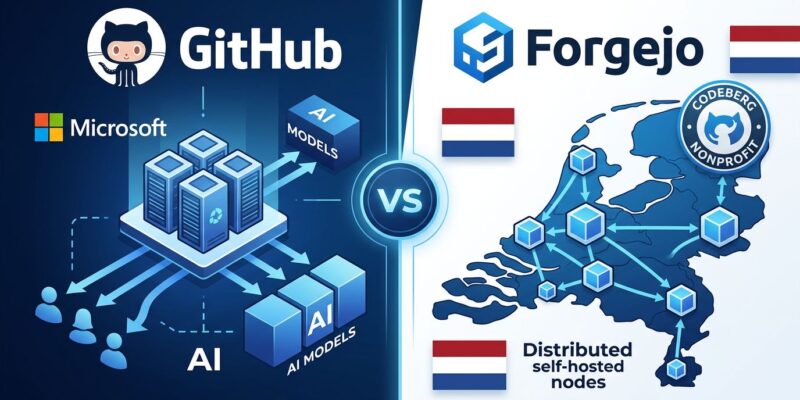
On April 24, 2026, the Netherlands government soft-launched code.overheid.nl—a self-hosted, Forgejo-powered code platform for government agencies. This makes the Netherlands the first major government to build national Git infrastructure independent of GitHub or GitLab. Multiple ministries (Finance, Foreign Affairs, Agriculture, Interior) and major cities (The Hague, Utrecht, Leiden, Arnhem) have already onboarded. Furthermore, the timing isn’t coincidental: April 24 is the same day GitHub’s controversial AI training opt-out policy took effect.
Why the Netherlands Dumped GitHub
Three factors drove this decision: digital sovereignty, data control, and governance. Moreover, the Netherlands isn’t alone in questioning US tech dependency—the EU relies on non-EU sources for over 80% of digital products and services, with just three US companies controlling 65% of the EU cloud market.
GitHub’s April 24 policy change was the catalyst. The platform switched to opt-out for AI model training, meaning Free, Pro, and Pro+ users now have their code—including interaction data from private repositories—collected and fed to Microsoft’s models unless they manually disable it. There’s no repository-level control, so maintainers can’t protect their projects. Additionally, the data flows to Microsoft’s CoreAI division, which absorbed GitHub in August 2025.
A Dutch developer blog post from May 8 put it bluntly: “GitHub represents centralized corporate control prioritizing AI monetization over user sovereignty.” For a government managing citizen data and critical infrastructure, that’s not a feature—it’s a liability. Consequently, add jurisdictional concerns (US FISA Section 702, CLOUD Act) and GitHub’s reliability issues (257 incidents and 48 major outages between May 2025 and April 2026), and the case for independence becomes obvious.
Enter Forgejo: The Non-Profit Alternative
Forgejo (pronounced “for-JAY-oh”) is a hard fork of Gitea that emerged in October 2022 after Gitea’s lead maintainer silently transferred the project to a for-profit company. Contributors revolted, wrote an open letter demanding community control, and when that failed, forked the project under Codeberg e.V., a German non-profit. By February 2024, Forgejo had split entirely from Gitea. In August 2024, it switched from MIT to GPLv3+ licensing to prevent commercial capture—the very thing that spawned the fork in the first place.
Forgejo v15.0 LTS shipped on April 16, 2026—just days before the Netherlands launch. This 100th release milestone signals production readiness, with long-term support through July 2027. The platform offers GitHub-compatible Actions for CI/CD, self-hosting control, and the option of free hosting on Codeberg.org. Unlike GitHub, Forgejo is governed collectively by contributors, with Codeberg e.V. providing resources but maintaining governance independence.
Developers Are Migrating Too
The Netherlands move validates a broader trend. A May 8 developer blog post titled “Why I’m leaving GitHub for Forgejo” gained 214 points and 135 comments on Hacker News. The author cited four drivers: organizational control loss (GitHub’s absorption into Microsoft CoreAI), AI training concerns, jurisdictional risk, and reliability problems. Migration tools like github2forgejo scripts (available from PatNei and RGBCube repos) now support transferring repos, issues, PRs, labels, releases, and wikis—either one-time or via continuous mirroring.
However, the migration isn’t frictionless. Forgejo Actions aims for familiarity, not full GitHub Actions compatibility. Most standard workflows (checkout, setup-node, cache) work unchanged, but actions/checkout@v6 broke authenticated checkout on non-GitHub runners in early 2026. As one migration guide noted: “If you lean heavily on GitHub-specific features, migration is a project, not an evening.” Still, for privacy-conscious developers and sovereignty-minded organizations, that’s a trade-off worth making.
What Happens Next
Netherlands is a pilot, not an endpoint. Germany and France—both with strong open source cultures and digital sovereignty priorities—are prime candidates to follow. The EU’s Tech Sovereignty Package, expected May 27, includes the Cloud and AI Development Act (CADA) and Chips Act 2.0, backed by €80 billion for semiconductors and €200 billion for AI compute. This isn’t theory—it’s policy.
As a result, GitHub’s government market share in Europe is now at risk. The platform has shown no signs of reversing its AI policy, which is core to Microsoft’s strategy. Can Forgejo scale for nation-level workloads? The v15.0 LTS release and multi-year support commitment suggest yes, but it’s unproven at this scale. The bigger question is whether governments will wait to find out or simply accept some friction in exchange for control.
In fact, this might be the moment when governments realized big tech dependency isn’t a convenience—it’s a liability. The Netherlands didn’t build code.overheid.nl to make a political statement. They built it because trusting Microsoft with their code stopped making sense the day GitHub started training models on it.