 By
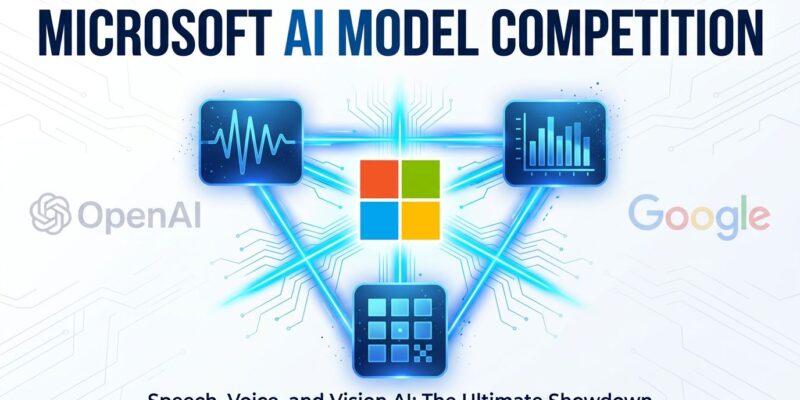
By On April 2, Microsoft launched three proprietary foundational AI models—MAI-Transcribe-1, MAI-Voice-1, and MAI-Image-2—marking its first major move to build competitive alternatives to OpenAI and Google while maintaining its existing partnership. Developed by Microsoft’s MAI Superintelligence Team led by former DeepMind co-founder Mustafa Suleyman, the models are available exclusively on Microsoft Foundry (Azure) and already power Copilot, Bing, and PowerPoint. This signals a fundamental shift from exclusive cloud-provider partnerships to what might be called “competitive collaboration”—Microsoft simultaneously partners with OpenAI AND competes by building its own models.
MAI-Transcribe-1 Beats Whisper at Half the GPU Cost
Microsoft’s first speech recognition model claims to outperform OpenAI’s Whisper-large-v3 while running at 50% lower GPU cost. According to Microsoft’s official announcement, MAI-Transcribe-1 achieves 3.9% Word Error Rate on the FLEURS multilingual benchmark across 25 languages, compared to Whisper’s 7.6% WER. Moreover, it beats Google Gemini 3.1 Flash on 22 of 25 languages and processes batch transcriptions 2.5x faster than Microsoft’s existing Azure Fast offering.
However, there’s an important caveat. FLEURS is based on clean read speech, not real-world noisy environments like call centers or field recordings. Microsoft’s benchmark numbers are vendor-provided and not yet independently verified. Consequently, you should test on your actual workloads before assuming 50% cost savings will materialize in production.
The bigger story is strategic. Enterprise Azure customers now have a choice: OpenAI Whisper (cross-platform, open-source) or Microsoft’s proprietary MAI-Transcribe-1 (Azure-exclusive, but potentially cheaper and faster). Clearly, Microsoft is using cost efficiency as a competitive weapon to attack OpenAI’s enterprise margins.
Partnership Intact, Competitive Tension Rising
Microsoft and OpenAI released a joint statement in February 2026 reaffirming their partnership despite OpenAI securing $110 billion in funding from Amazon, Nvidia, and SoftBank. Azure hosting continues, revenue sharing remains intact, and any third-party OpenAI collaboration (including Amazon) must route API calls through Azure.
Nevertheless, competitive dynamics are emerging beneath the surface. An internal OpenAI memo obtained by CNBC admitted Microsoft has “limited our ability” to reach enterprise clients. Meanwhile, Microsoft’s MAI models are available ONLY on Foundry, not OpenAI’s API—signaling Microsoft’s strategy to own the full stack from infrastructure to models to applications.
Related: Google Bets $40B on Anthropic: AI Infrastructure War Heats Up
This is “competitive collaboration” in action. Both companies maintain deep integration while simultaneously developing alternative capabilities and partnerships. Furthermore, developers should expect more proprietary Azure-exclusive models as Microsoft hedges against OpenAI’s multi-cloud expansion.
Voice Cloning and Image Generation Round Out Suite
MAI-Voice-1 generates 60 seconds of expressive audio in under 1 second on a single GPU and supports instant voice cloning from 10-second samples. No fine-tuning required. Microsoft prices it competitively at $22 per million characters, matching Azure Neural HD voices, but requires responsible AI approval for voice cloning to prevent deepfake abuse.
MAI-Image-2 debuted at #3 on the Arena.ai global leaderboard for text-to-image models based on human-preference voting. It ranks behind only Google and OpenAI’s top models, ahead of FLUX and GPT-Image on certain metrics. Additionally, generation speed is 2x faster than its predecessor, with strengths in photorealism and text rendering.
The limitations matter. MAI-Image-2 only outputs square images, caps Copilot users at 15 images per day, and applies aggressive content filtering. The daily limit suggests Microsoft is protecting Foundry API revenue by throttling free Copilot access. Therefore, if you need higher volume or non-square formats, you’ll need to pay for the enterprise API or look elsewhere.
What This Means for Developers
Microsoft is diversifying from OpenAI dependency while maintaining the partnership. The MAI models give Azure customers competitive alternatives with claimed cost advantages (50% lower GPU for transcription) and performance improvements (2.5x faster batching, 2x faster image generation).
However, there’s a trade-off. MAI models are Foundry-exclusive. No OpenAI API access, no cross-cloud deployment. Microsoft wants you locked into the Azure ecosystem. Conversely, if multi-cloud portability matters, Whisper’s open-source model remains the better choice despite potentially higher GPU costs.
The Azure-exclusive strategy also reveals Microsoft’s endgame: compete on the full stack (infrastructure + proprietary models + applications) rather than just hosting OpenAI’s models. Expect this pattern to continue as cloud providers shift from pure infrastructure partnerships to direct model competition.
Key Takeaways
- Microsoft launched three MAI models (speech, voice, image) on April 2 as first in-house alternatives to OpenAI/Google
- MAI-Transcribe-1 claims 3.9% WER (vs Whisper’s 7.6%) at 50% lower GPU cost, but benchmarks are vendor-provided
- Microsoft-OpenAI partnership continues (Azure hosting, revenue sharing) while competitive tension emerges
- MAI models are Azure-exclusive, signaling vendor lock-in strategy over cross-cloud portability
- “Competitive collaboration” dynamic: cloud providers now compete on proprietary models while maintaining infrastructure partnerships