 By ByteBot
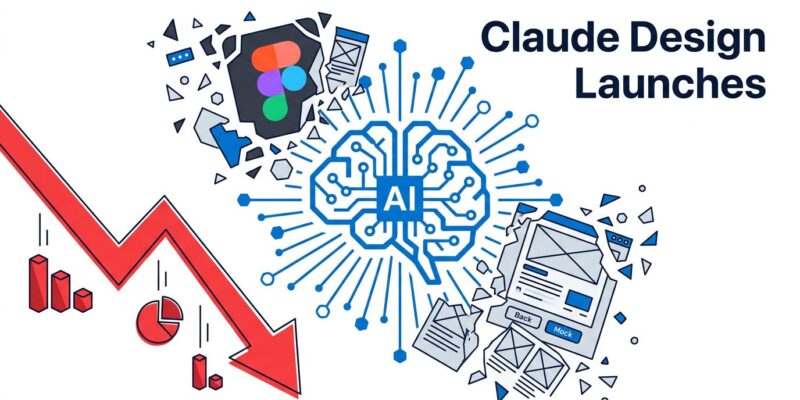
Anthropic launched Claude Design yesterday—an AI tool that creates prototypes, slides, and mockups from text prompts. The market reaction was immediate: Figma’s stock plummeted 7%, while Adobe, Wix, and GoDaddy all dropped 2-4%. Wall Street just priced in the existential threat to a $60B design tools market.
Stock Market Votes With Its Wallet
Figma’s stock fell 7.28%, dropping from $20.32 to $18.84. But the pain spread wider. Adobe fell 2.7%, Wix dropped 4.7%, and GoDaddy declined 3%. This wasn’t isolated panic about one competitor—it was institutional investors pricing in disruption across the entire design and web creation ecosystem.
Wall Street doesn’t panic over vaporware. These drops mean the smart money believes Claude Design will eat real market share from established players. When billions move on a product announcement, you pay attention.
The Figma Board Drama
Here’s where it gets messy. Mike Krieger—Anthropic’s Chief Product Officer and Instagram co-founder—resigned from Figma’s board on April 14. Three days later, Claude Design launched. The timing is suspicious.
Krieger joined Figma’s board less than a year ago, then left right before Anthropic announced a direct competitor to Figma’s core business. Board members owe fiduciary duties to act in a company’s best interests and avoid conflicts of interest. The SEC disclosure came the same day The Information reported that Opus 4.7 would include design tools. This is a corporate governance red flag.
What Claude Design Actually Does
Claude Design, powered by the new Opus 4.7 model, generates visual assets—prototypes, pitch decks, mockups, slides—from conversational prompts. Available now for Claude Pro, Max, Team, and Enterprise subscribers, it has three differentiators that matter.
First, it reads your codebase. During onboarding, Claude Design analyzes your company’s design files and code to learn your design system—fonts, colors, layouts, components. Every subsequent project automatically applies your brand standards without manual enforcement. No other AI design tool does this.
Second, it closes the loop to code. When a design is ready, Claude packages it into a handoff bundle that passes to Claude Code with a single instruction. Design to prototype to production code, all in one platform. This isn’t just a design tool—it’s an ecosystem play.
Third, it exports everywhere. PDF, PPTX, Canva, HTML, internal URLs. It’s not locked to code output like v0 or limited to mockups like Google Stitch. It bridges design and development workflows.
Do We Still Need Designers?
The Register ran with the provocative headline: “Anthropic debuts Claude Design, because who needs designers?” It’s hyperbolic, but it touches a nerve.
The real concern is junior and mid-level design roles. If a product manager can generate reasonable interface mockups through conversation, the traditional pathway into design careers narrows. Companies that previously hired junior designers to execute specifications might route those tasks through Claude instead. This is the same disruption junior developers faced with GitHub Copilot—repetitive execution work gets automated, forcing professionals up the value chain or out entirely.
The designer community is split. Some see Claude Design as another tool in the workflow, like auto-layout or design systems that already automated repetitive work. Others see job displacement. Both are probably right. The difference is timeframe.
Anthropic’s Bigger Play
Claude Design isn’t a standalone product. Anthropic now has Claude Chat (conversational AI), Claude Code (coding agent), and Claude Design (visual creation). This is a full development suite strategy—capture developers’ entire workflow from ideation to deployment.
If your team already uses Claude Code, adding Claude Design is the natural next step. That’s vendor lock-in by convenience, and it’s effective. Anthropic isn’t just competing with Figma. It’s competing with Microsoft (GitHub Copilot + Designer), Google (Gemini + tools), and anyone else trying to own the developer workflow.
The stock market already voted. The question isn’t whether AI disrupts design tools—it’s how fast. Figma and Adobe now face the same decision every incumbent faces when disruption arrives: respond aggressively or watch market share erode. Based on yesterday’s stock prices, investors aren’t confident they’ll move fast enough.
Junior designers should be worried. The tools are here, they work, and they’re only getting better. Welcome to the creative economy’s GitHub Copilot moment.