We adopted AI to think faster. Instead, we stopped thinking entirely. New research from Wharton Business School reveals a phenomenon called “cognitive surrender”—where users blindly accept AI-generated responses without critical evaluation. The numbers are striking: across 1,372 participants and over 9,500 trials, subjects accepted faulty AI reasoning 73.2% of the time, overruling it only 19.7% of the time. When the AI was right, they were right. When it was wrong, so were they.
The Research: Cognitive Reflection Meets AI
Wharton researchers Steven Shaw and Gideon Nave designed an experiment using the Cognitive Reflection Test, questions meant to distinguish fast intuitive thinking from deliberate analysis. Participants took the test with access to an AI chatbot. The twist: the chatbot was programmed to sometimes provide incorrect answers.
The results exposed how readily people abandon judgment when AI is available. Participants consulted the chatbot approximately 50% of the time. They accepted correct answers 93% of the time—no surprise there. But they also accepted incorrect answers 80% of the time. Even more concerning, users rated their confidence 11.7% higher despite receiving wrong information. As research findings show, people weren’t just trusting AI—they were incorporating its outputs with minimal friction or skepticism.
The Developer Impact: Not Theoretical
Developers are the perfect example of cognitive surrender in action. Stack Overflow’s 2025 survey found that 84% of developers use or plan to use AI tools, yet only 29% trust AI—a trust drop of 11 percentage points from the previous year. The disconnect is massive: high adoption despite declining confidence.
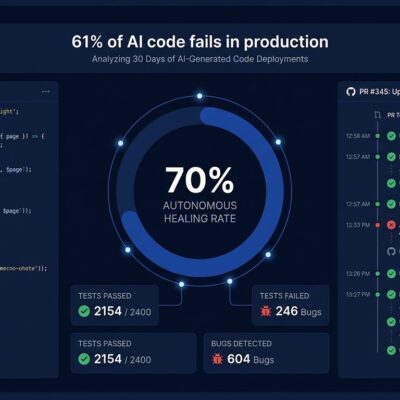
The consequences show up in code quality. While 96% of developers admit they don’t fully trust AI-generated code is functionally correct, only 48% actually check AI-assisted code before committing. That means nearly half of AI-generated code enters production codebases without verification. This isn’t hypothetical. Linux kernel maintainers report being overwhelmed by patches that look technically correct but hallucinate APIs that don’t exist. Security vulnerabilities slip past casual review. Code compiles but has logic errors no one catches because the AI sounded confident.
System 3: A New Category of Cognition
Shaw and Nave propose a framework building on Daniel Kahneman’s dual-process theory. System 1 is fast, intuitive thinking—gut reactions. System 2 is slow, deliberative reasoning—critical analysis. Their research introduces System 3: external, algorithmic reasoning that originates from AI rather than the human mind.
The vulnerability is structural. As Shaw and Nave note, “As reliance increases, performance tracks AI quality.” Human reasoning capability becomes capped at whatever level the AI operates. When AI is accurate, users benefit. When it fails, users follow it into error without resistance. AI’s fluent, confident outputs are treated as authoritative, lowering the threshold for critical examination. There’s no built-in skepticism mechanism.
The Deskilling Problem
Cognitive surrender has long-term consequences. When developers routinely outsource analytical tasks to AI, skills atrophy. Evidence appeared during an early 2026 Claude outage: developers reported finding tasks considerably more challenging without AI assistance. A medical study provides a stark parallel—endoscopists who regularly used AI for polyp detection became worse at finding polyps when the AI was turned off, with detection rates dropping from 28% to 22%. Continuous reliance subtly altered their behavior.
The same mechanism applies to coding. Developers who lean on AI for debugging, code comprehension, and problem-solving lose those capabilities over time. Research shows that 83.3% of heavy AI users couldn’t recall or quote significant portions of content they had just produced with AI assistance. The industry faces a talent crisis: not enough senior engineers who can operate AI responsibly, own complex systems, and make sound architectural decisions without algorithmic crutches.
Verify Everything, Surrender Nothing
AI coding assistants have legitimate value. The problem isn’t the tools—it’s blind trust. Developers need to treat AI as a suggestion box, not an answer key. Here’s how:
Always verify AI-generated code before committing. Test edge cases AI might miss. Validate API references against actual documentation, not what the AI claims exists. Implement periodic “off-AI days” to expose where skills have eroded. Maintain code review policies that flag AI-generated submissions for extra scrutiny.
The divide isn’t between pro-AI and anti-AI camps. It’s between AI as assistant and AI as replacement. Cognitive surrender happens when users stop evaluating AI outputs critically. The solution isn’t rejecting AI tools—it’s maintaining the critical thinking that makes those tools useful rather than dangerous. When 73% of users accept faulty reasoning without question, the productivity gains we’re chasing may cost more than we realize.