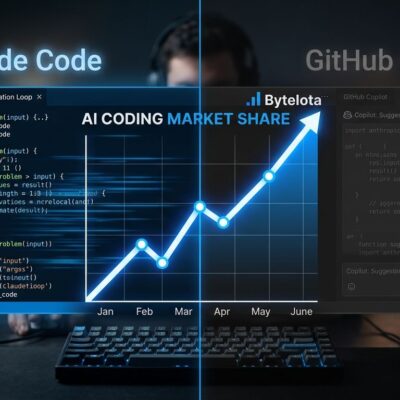
Cursor launched Cursor 3 on April 2—a complete redesign that transforms their AI-powered code editor from a VS Code fork into a “unified workspace for building software with agents.” Instead of a single AI assistant suggesting code, developers now orchestrate teams of AI agents working in parallel across repositories, cloud environments, and platforms like Slack and GitHub. This is Cursor’s direct answer to Claude Code and OpenAI’s Codex in the rapidly consolidating $4 billion AI coding market.
Moreover, the launch matters because 84% of developers already use AI coding tools, with 75% relying on AI for half or more of their work. Consequently, the question isn’t whether AI agents will change software development—it’s which platform will define how. Cursor ($2 billion ARR, 360,000 subscribers), Claude Code (Anthropic), and Codex (OpenAI) are fighting to set that standard.
Three Tools, Three Paradigms—and One Winner Takes All
Cursor 3 enters a three-way battle where each competitor represents a fundamentally different approach to AI-assisted development. Furthermore, the AI coding market is worth $12.8 billion today and projected to hit $127 billion by 2032—but it’s consolidating fast, and most developers will only pay for one or two tools.
Here’s what each brings to the table. Cursor 3 is the visual IDE: multi-file editing, Design Mode that lets you point to UI elements, and familiar VS Code-like interface. Think interactive development with agents you manage. Claude Code is terminal-native with a 1 million token context window—best for large codebase analysis and architectural decisions where other tools lose track after a few files. Meanwhile, Codex is the autonomous option: spin up a sandboxed VM, let it work independently, get a pull request.
However, most professional developers aren’t choosing one—they’re stacking tools. The common pattern: Cursor for daily implementation plus Claude Code for complex refactoring. That’s $40/month for a complete AI coding stack, which beats paying $200 for Codex alone. In fact, the real winner might be whoever forces developers to choose just one.
From Code Editor to Agent Manager
Cursor 3’s fundamental shift is in the developer’s role. Old Cursor suggested code while you typed. New Cursor 3 makes you an orchestrator: launch multiple AI agents, point them to repos or UI elements, let them work in parallel, then review and merge their output. As a result, the Cursor team calls this “the third era of software development where agent fleets work autonomously.”
Additionally, the technical changes back this up. You can run agents locally, in worktrees for isolated tasks, in cloud environments, or on remote SSH servers—all visible in one sidebar. Design Mode lets you annotate a web page and tell an agent “fix that button” by pointing directly at it. Furthermore, local-cloud handoff means starting an agent in the cloud, closing your laptop, and picking up hours later when it’s done.
This isn’t iteration—it’s a rebuild from scratch. Cursor 3’s interface was written specifically for agent workflows, not bolted onto VS Code like previous versions. Therefore, the new commands like /worktree and /best-of-n (for comparing multiple models on the same task) make agent orchestration a first-class feature, not an add-on.
The Reality Check: Bugs, Trust, and Cost Creep
However, Cursor’s aggressive iteration comes with real problems. In March 2026, a code reversion bug silently undid developer changes—Cursor confirmed three root causes but couldn’t say how many users were affected. That kind of bug doesn’t just annoy developers; it breaks fundamental trust when you’re relying on agents to write production code.
Beyond bugs, there’s the daily friction. Users complain the UI changes weekly, forcing constant reconfiguration. One Reddit comment: “Can you NOT change the UI every week … it is infuriating as hell.” Then there’s cost: Cursor Pro starts at $20/month but heavy users report bills climbing to $40-50/month with usage overages.
Consequently, developer reactions split along expected lines. Fireship praised Cursor as “the first editor that makes AI feel native rather than bolted on.” Meanwhile, ThePrimeagen called it “dangerously lazy” while grudgingly admitting the multi-file editing is “legitimately impressive.” Moreover, a study on open source projects found AI tools like Cursor deliver “speed at the cost of quality”—a trade-off developers need to make consciously.
What This Means for Developers Right Now
The shift from AI-assisted coding to agent orchestration is happening whether individual developers are ready or not. In fact, the numbers show adoption is already mainstream: 51% of developers use AI tools daily, 56% do 70% or more of their engineering work with AI assistance. Additionally, the average developer saves 3.6 hours per week, and daily AI users merge 60% more pull requests than their peers.
Consequently, that creates a skills gap. The valuable abilities are shifting fast: architecture, orchestration, and verifying agent output matter more; writing boilerplate and routine implementations matter less. Therefore, junior developer positions are declining because agents handle entry-level tasks—companies hire fewer juniors when agents can generate tests and documentation.
For individual developers, the decision tree is straightforward. If you’re budget-conscious, pick one: Cursor Pro or Claude Pro at $20/month. However, if you’re a professional doing this daily, the standard stack is Cursor + Claude Code for $40/month total. Meanwhile, enterprises can afford the full toolkit—Cursor for implementation, Claude for planning, and selective Codex use for automation.
The brutal truth: developers who don’t adapt to agent workflows won’t be replaced by AI—they’ll be replaced by developers who use AI. The tools are imperfect, the bugs are real, but the shift is irreversible. Consequently, waiting for stability means falling behind.