 By ByteBot
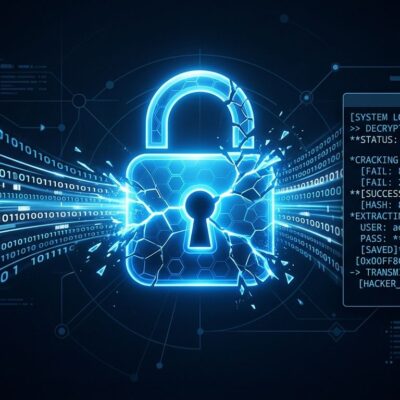
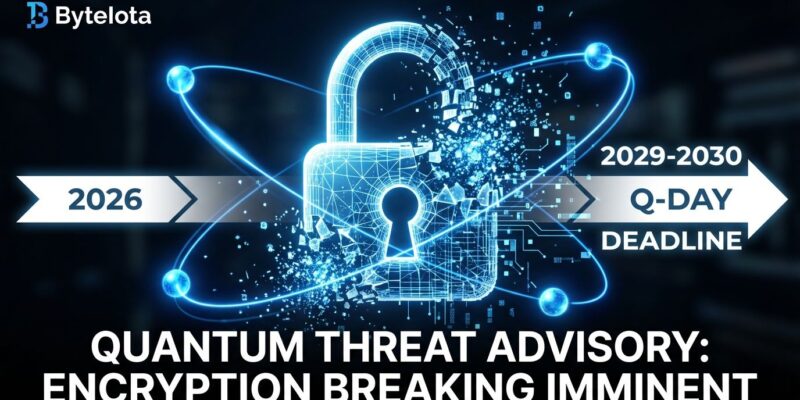
Google dropped a quantum cryptography bombshell this week. Researchers revealed that breaking elliptic curve cryptography (ECC) now requires 20 times fewer quantum resources than previously estimated. Future quantum computers could crack Bitcoin’s encryption with fewer than 500,000 physical qubits in minutes—not the 10 million qubits experts thought would take decades. The timeline for “Q-Day” (when quantum computers break today’s encryption) just accelerated from “someday” to 2029-2030.
ECC secures nearly every HTTPS connection, SSH session, cryptocurrency wallet, code signature, and VPN on the internet. The “store now, decrypt later” threat isn’t theoretical—state actors are harvesting encrypted traffic today for future decryption.
20x Fewer Qubits: Q-Day Arrives in 2029-2030
Google’s March 2026 research shattered the timeline. Breaking ECC’s secp256k1 curve—used by Bitcoin and Ethereum—requires roughly 1,200 logical qubits and fewer than 500,000 physical qubits. That’s a 20-fold reduction from the 10 million qubit estimate that dominated industry planning.
Attack time: minutes on superconducting quantum systems. Not decades. Not years. Minutes.
Bitcoin’s 10-minute block time gives quantum computers ample opportunity to forge signatures and drain wallets. Ethereum’s 12-second block time offers slight protection but doesn’t eliminate the risk. The broader impact extends far beyond cryptocurrency—every TLS handshake, every SSH connection, every signed software package relies on cryptography that will become trivially breakable.
Google Quantum AI was direct: “The 2029–2030 timeframe is no longer a conservative estimate, but an active deadline for the digital economy.” Organizations that assumed they had 20+ years to migrate now have 3-4 years maximum.
State Actors Are Storing Your Encrypted Traffic Today
The worst part? The attack is already underway. State-sponsored actors are harvesting TLS/HTTPS traffic, VPN sessions, and encrypted communications with explicit intent to decrypt them once quantum computers arrive. Even if you migrate to post-quantum cryptography in 2027, data captured in 2026 is already compromised.
TLS sessions contain key exchanges (ECDHE) that will be trivially breakable with cryptographically relevant quantum computers (CRQCs). Medical records with 50-year retention, financial data with 7-year legal holds, and government secrets with indefinite confidentiality requirements are all at risk.
The NSA’s CNSA 2.0 mandate—requiring compliance by January 2027 for new government acquisitions—acknowledges this urgent threat. The clock started years ago when adversaries began bulk collection.
Related: Axios npm Hit by North Korean Supply Chain Attack
NIST Post-Quantum Cryptography Standards Provide the Path Forward
Developers have a clear roadmap. NIST released three finalized post-quantum cryptography standards in August 2024: ML-DSA for digital signatures, ML-KEM for key exchange, and SLH-DSA as an alternative signature scheme. These algorithms underwent an 8-year international competition before standardization.
The recommended strategy is hybrid PQC—running classical ECC and quantum-safe algorithms simultaneously. Both ECDHE and ML-KEM derive session keys. If one algorithm is broken, the other still protects the connection. This hedges against unknown weaknesses in new cryptography while maintaining backward compatibility.
Google’s Android 17 already integrates ML-DSA protection. Cloud providers are rolling out PQC support throughout 2025-2026. The tooling exists—OpenSSL, Bouncy Castle, and liboqs provide drop-in replacements. Start with TLS endpoints, SSH servers, and authentication flows.
Regulatory Deadlines Are Mandatory
This isn’t a “wait and see” situation. US government contractors must comply with NSA’s CNSA 2.0 by January 1, 2027 for all new National Security System acquisitions. EU critical infrastructure faces mandatory migration by end of 2030. Financial services and healthcare sectors see emerging compliance deadlines in 2026-2027.
Even organizations outside regulated sectors face pressure. Supply chain requirements cascade—if you sell to government contractors, you’ll need PQC compliance to maintain contracts. The compliance hammer is coming, and it won’t be gentle.
Key Takeaways
- Q-Day is 2029-2030, not “someday”—Google’s research cut quantum resource requirements by 20x, accelerating the timeline from decades to years
- “Store now, decrypt later” attacks are already active—state actors are harvesting encrypted traffic today for future decryption, making immediate migration planning critical for long-lived data
- NIST standards (ML-DSA, ML-KEM, SLH-DSA) provide a clear path—hybrid PQC running classical and quantum-safe algorithms simultaneously is the recommended approach
- Regulatory deadlines are hard—CNSA 2.0 requires compliance by January 2027, EU mandates critical infrastructure migration by 2030, and supply chain pressure will force broader adoption
- Prioritize intelligently—medical records, financial archives, and intellectual property with 10+ year confidentiality needs should migrate first, followed by external-facing systems and high-value targets
The quantum clock is ticking. Google’s research removed the comfort of distant timelines. Start cryptographic inventories now, deploy hybrid PQC where it matters most, and don’t wait for Q-Day—by then, it’s too late.