
 By ByteBot
ByteDance open-sourced DeerFlow 2.0 on February 28, 2026, and it immediately claimed the #1 spot on GitHub Trending, accumulating over 45,000 stars. This isn’t another LLM wrapper or chat library. DeerFlow is production infrastructure for autonomous AI agents—batteries included, Docker-isolated, built for real deployments.
Most agent frameworks hand you primitives and wish you luck. LangChain gives you chains. AutoGPT gives you loops. DeerFlow gives you a runtime: sandboxed execution environments, parallel sub-agent orchestration, persistent memory, and extensible skills. This is what agent frameworks should have been from the start.
Runtime Infrastructure, Not Just Abstractions
DeerFlow’s core insight is simple: developers don’t need another library of LLM abstractions. They need infrastructure that works. Each task runs in an isolated Docker container with its own filesystem, bash terminal, and browser. Think of it as a “computer-in-a-box” for your AI agent.
This architectural choice matters. When your agent needs to execute code, it’s not simulating a filesystem or pretending to run commands. It has a real environment. When it needs to install dependencies, test code, or debug failures, it operates like a developer would—because it has the same tools.
The framework supports three deployment modes: local for development, Docker for single-server production, and Kubernetes for multi-server enterprise deployments. ByteDance didn’t build a prototype. They built a system that scales from your laptop to production infrastructure.
Progressive skill loading keeps costs down. DeerFlow only loads capabilities when needed, minimizing token usage for long-running tasks. It’s a small detail that shows production thinking—when agents work for hours, every wasted token compounds.
Sub-Agent Orchestration for Complex Tasks
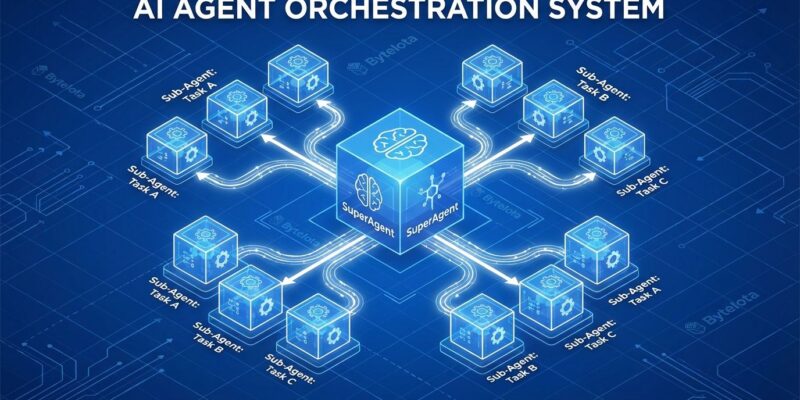
DeerFlow’s SuperAgent decomposes complex objectives into specialized sub-tasks and spawns multiple sub-agents that execute in parallel. For instance, one sub-agent scrapes the web for funding data while another conducts competitor analysis and a third generates visualizations—simultaneously.
Serial execution is a bottleneck we accept too easily. LLM agents waiting on each other waste time and money. In contrast, DeerFlow’s parallel architecture solves real problems faster. A research task that would take an hour sequentially completes in 15 minutes with parallel sub-agents.
Real-world applications demonstrate this. Developers are using DeerFlow for autonomous research (gather sources, cite them, generate reports with charts), full-stack development (from prompt to working codebase with tests), content production (slide decks, web pages, videos), and data pipeline automation. These aren’t toy examples—they’re production workloads.
The key difference between DeerFlow and earlier agent frameworks? DeerFlow handles tasks that take minutes to hours. AutoGPT demos well but breaks on long tasks. LangChain requires you to build the orchestration yourself. Meanwhile, DeerFlow ships the infrastructure.
Production Deployment vs Toys
AutoGPT has 167,000 GitHub stars because it’s fun to play with. DeerFlow accumulated 45,000 stars in less than a month because developers can actually deploy it. That’s the difference between a demo and a tool.
Security matters in production. DeerFlow’s Docker isolation prevents code execution from contaminating host systems. Each agent runs in a separate container, limiting blast radius if something goes wrong. This approach becomes critical after supply chain incidents like the March 2026 LiteLLM PyPI attack, where compromised dependencies targeted exactly the credentials AI agents manage.
The MIT License removes adoption friction. Companies can use DeerFlow in proprietary products, modify it freely, and deploy it internally without licensing concerns. Moreover, ByteDance chose the right license for enterprise adoption.
Integration flexibility matters too. Specifically, DeerFlow exposes a REST API for microservices, provides a Python library for application embedding, and supports messaging platforms like Slack, Telegram, and Feishu. Additionally, it integrates with MCP (Model Context Protocol) for extensibility. This isn’t academic—it’s built for real engineering teams.
How DeerFlow Stacks Up Against Alternatives
DeerFlow sits between LangChain’s flexibility and AutoGPT’s simplicity. It’s more complete than LangChain for production but more structured than AutoGPT for enterprise needs.
LangChain excels at chat-based interactions where you need precise control over prompt chains. However, for autonomous multi-hour tasks, you’re building the infrastructure yourself. Conversely, DeerFlow provides that infrastructure out of the box.
AutoGPT pioneered the autonomous agent concept, but it’s exploratory by design. Good for experimentation, harder for production. DeerFlow learned from AutoGPT’s UX but built for deployment, not demos.
CrewAI offers role-based agent coordination, which works when you know your roles upfront. In comparison, DeerFlow’s sub-agent spawning is more dynamic—the SuperAgent decides what specialized agents to create based on the task.
Choose DeerFlow when you need autonomous agents working minutes to hours, complex multi-step objectives requiring orchestration, safe code execution in sandboxed environments, or persistent memory across sessions. Skip it for simple chat interactions (LangChain is easier), exploratory prototyping (AutoGPT is looser), or when you want 100% control (custom build gives you that).
The Bottom Line
Agent orchestration is maturing from research projects to production infrastructure. DeerFlow represents ByteDance’s bet on what that infrastructure should look like: Docker-isolated, sub-agent orchestrated, batteries-included runtime built for real deployments.
The #1 GitHub Trending position and 45,000+ stars signal more than hype. Developers are tired of building agent infrastructure from scratch. They want tools that work out of the box. ByteDance gets it.
If you’re evaluating agent frameworks for production, DeerFlow deserves serious consideration. It won’t replace every use case—LangChain still wins for chat, AutoGPT for experimentation—but for autonomous multi-hour tasks, it’s the most production-ready option available.


