
 By ByteBot
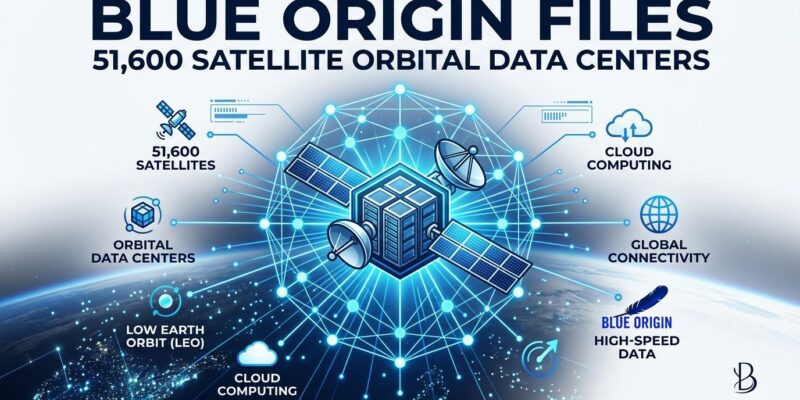
Blue Origin filed an FCC application for 51,600 satellites on March 19, 2026. Project Sunrise aims to build orbital AI data centers in sun-synchronous orbits between 500 and 1,800 kilometers. This is Jeff Bezos’ answer to Elon Musk’s million-satellite proposal filed earlier this year. The space race for AI infrastructure just escalated dramatically.
What Blue Origin Actually Proposed
Project Sunrise calls for 51,600 satellites operating in sun-synchronous circular orbits. Each orbital plane would contain 300 to 1,000 satellites, spaced 5 to 10 kilometers apart in altitude. Unlike traditional satellite constellations that relay communications, these satellites are the data centers. They process and compute AI workloads in orbit rather than just bouncing signals to Earth.
The technical approach relies on optical laser links between satellites instead of radio frequencies. Data routes through Blue Origin’s existing TeraWave constellation of 5,408 satellites before transmitting to ground stations. It’s a mesh network in space, designed to handle the massive data throughput AI training requires.
The Infrastructure Crisis Driving Orbital Data Centers
AI models are hitting the physical limits of terrestrial data centers. Power and cooling constraints are the bottleneck. A single 40-megawatt ground-based cluster consumes over one million tons of water annually just for cooling. Next-generation AI models need 5-gigawatt clusters, which simply aren’t feasible on Earth with current infrastructure.
Blue Origin’s FCC filing argues that orbital data centers can “address insatiable demand for AI workloads” by operating “independently of Earth-based constraints.” The pitch is straightforward: sun-synchronous orbits provide 24/7 solar power without weather or night interruptions. Passive radiative cooling to the vacuum of space eliminates energy-intensive chillers and water consumption entirely. The modular design scales linearly without land or regulatory limits.
This isn’t theoretical. Starcloud trained an LLM in space using NVIDIA H100 hardware in 2025. China launched orbital data center satellites in May 2025. Google announced Project Suncatcher for 2027. The infrastructure is real, even if the economics remain questionable.
Bezos vs Musk: The Real Story
SpaceX filed for up to one million satellites for orbital data centers earlier in 2026. Blue Origin responded with 51,600. The numbers tell part of the story, but the FCC battle reveals the strategy.
Amazon, which Bezos founded, filed an objection to SpaceX’s application in March. Amazon called the SpaceX plan “incomplete, speculative, and unrealistic,” arguing it provided “only the barest outline” and could take “centuries” to complete. SpaceX hit back immediately, asking the FCC to apply Amazon’s same criticisms to Blue Origin’s Project Sunrise filing.
FCC Chair Brendan Carr sided with SpaceX. His response to Amazon: “Focus on the fact that it will fall roughly 1,000 satellites short of meeting its upcoming deployment milestone, rather than spending their time and resources filing petitions against companies that are putting thousands of satellites in orbit.”
Blue Origin took its own shot at SpaceX, calling the million-satellite plan “profoundly disproportionate” and a risk to the orbital environment. This is corporate warfare disguised as regulatory commentary. Two billionaires competing for control of AI compute infrastructure in space, using their companies and regulatory channels as weapons.
The Space Debris Problem Nobody Wants to Address
Starlink operates roughly 5,000 satellites as of 2026. Blue Origin wants 51,600. SpaceX wants a million. The orbital environment can’t sustain this without consequences. Kessler syndrome—a cascade of collisions creating an expanding debris field—becomes more probable with each satellite launched.
Blue Origin criticized SpaceX’s scale while proposing 10 times more satellites than Starlink currently operates. The hypocrisy is obvious, but the concern is valid. Collision risk increases exponentially, not linearly.
Environmental impact extends beyond orbit. Research shows orbital data centers could generate an order of magnitude more emissions than terrestrial equivalents when accounting for rocket launches and satellite reentry. Scientific American reports that burning hardware on reentry produces significant atmospheric pollution. The solar-powered compute advantage gets offset by launch emissions.
Gartner called orbital data centers “peak insanity” in 2026, citing prohibitive costs and unresolved technical challenges. Industry skepticism is warranted. Launch costs must decline substantially for economic viability. Radiation hardening, maintenance impossibility, and latency for real-time applications remain unsolved problems.
What Happens Next
The FCC will review both applications through public comment, technical analysis, and environmental assessment. Approval could take months or years. If granted, deployment adds additional years.
The likely outcome is approval with modifications. Reduced satellite counts, stricter debris mitigation requirements, and phased deployment milestones. Both Bezos and Musk have the capital and launch capability to execute if regulators allow it.
The stakes are control over AI compute infrastructure. Whoever dominates orbital data centers controls where next-generation AI models train and run. This isn’t about satellites. It’s about power—computational and geopolitical.
Blue Origin’s filing makes the space race for AI infrastructure undeniable. Whether it’s visionary or reckless depends on who you ask. The FCC will decide if it’s legal.


