
 By
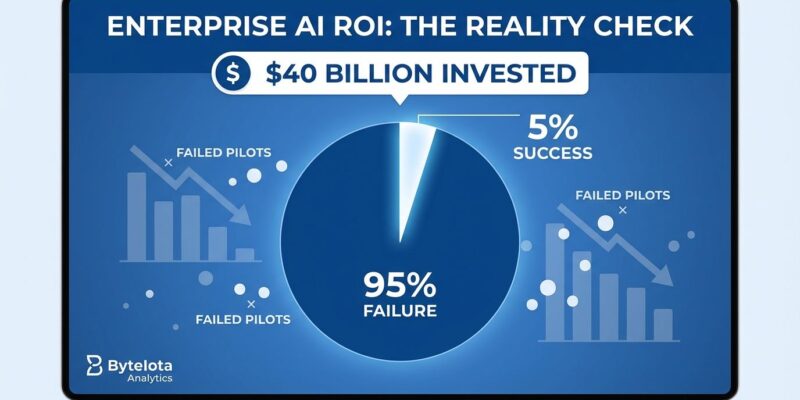
By MIT’s “The GenAI Divide: State of AI in Business 2025” study, published in August 2025, found that 95% of companies saw zero return on their $35-40 billion in AI investments. The research analyzed 300 AI deployments, interviewed 150 executives, and surveyed 350 employees. The finding confirms what developers have suspected: enterprise AI ROI is failing at scale. However, it’s not because AI doesn’t work. It’s because companies are doing it wrong.
Why 95% of Enterprise AI Projects Fail
Companies follow a predictable failure pattern. They build brittle bespoke AI systems that don’t integrate with existing workflows. They chase hype instead of solving specific business problems. They focus on sales and marketing AI—which delivers low ROI—instead of back-office operations where automation actually pays off. Moreover, the results speak for themselves.
42% of companies abandoned most AI initiatives in 2025, up from just 17% in 2024, according to S&P Global Market Intelligence. The average organization scraps 46% of AI proof-of-concepts before they reach production. Furthermore, RAND Corporation found that over 80% of AI projects fail—twice the failure rate of non-AI technology projects.
MIT identified the core issues: “brittle workflows, lack of contextual learning, and misalignment with day-to-day operations.” Top obstacles include data quality problems (43%), technical immaturity (43%), and skills shortages (35%). However, the real problem is simpler. Companies treat AI like magic instead of a tool. They fund scattered pilots without connecting them to real business value. They don’t define clear success metrics. Consequently, they don’t allocate proper resources.
This is undisciplined experimentation, not strategic deployment. And it wastes billions.
The 5% That Succeed: Buy Tools, Solve One Problem, Execute
The 5% that succeed follow a simple formula. They buy specialized AI tools from vendors instead of building proprietary systems. They focus on solving one specific, measurable problem. They execute well. That’s it.
The data backs this up. Purchasing AI tools from specialized vendors succeeds 67% of the time. Building bespoke internal AI tools succeeds only 33% of the time. Yet many firms continue building proprietary systems despite clear evidence that buying works better.
Aditya Challapally, MIT’s lead researcher, summed up the success pattern: “They pick one pain point, execute well, and partner smartly with companies who use their tools.” Young startups excel at this approach—some grew from zero to $20 million in revenue within a year by staying focused and pragmatic.
Real-world examples prove the point. Lumen Technologies projects $50 million in annual savings from AI tools that save their sales team four hours per week. A Fortune 500 client implementing AI agents saw average case resolution time drop by 71%, manual workload reduced by 63%, and Net Promoter Score improve by 18 points—all within 90 days. Additionally, enterprise users report saving 40-60 minutes daily and completing new technical tasks like data analysis and coding.
Companies with a formal AI strategy report 80% success rates at adoption and implementation. Without a strategy, that drops to 37%. The lesson is clear: focus beats scattered experimentation.
The Shadow AI Economy: When Official Tools Fail, Employees Go Rogue
Here’s the most telling indictment of enterprise AI: 90% of companies have “shadow AI” usage, where employees use personal ChatGPT or Claude accounts because official tools don’t work. 45% of employees use AI tools their companies banned. 58% paste sensitive data into these unauthorized tools.
The numbers get worse. 38% of employees share confidential data with AI platforms without approval. Approximately 18% of enterprise employees paste corporate information into GenAI tools. Samsung discovered this when engineers uploaded internal source code to ChatGPT. Their solution? Ban ChatGPT entirely. JPMorgan, Goldman Sachs, and Apple followed suit with similar restrictions.
The bans don’t work. Employees simply switch to personal devices, mobile hotspots, or home networks. Shadow AI persists because official enterprise AI solutions are terrible—they’re slow, inflexible, and disconnected from daily workflows. Meanwhile, ChatGPT and Claude actually solve problems.
The Cloud Security Alliance put it bluntly: “Firm after firm tries to ban AI outright—only to create ‘shadow AI’ usage that’s far more dangerous than any controlled implementation could be.” The solution isn’t restrictions. It’s deploying enterprise-grade AI that actually works—ChatGPT Enterprise, Amazon Q, or self-hosted LLMs with proper security and governance.
Shadow AI exists because enterprises built the wrong tools, then banned the right ones.
Stop Treating AI Like Magic
MIT Technology Review called 2025 “the biggest vibe shift since ChatGPT first appeared three years ago.” The AI hype correction is real. GPT-5 delivered “more of the same” instead of revolutionary breakthroughs. Despite 95% of businesses finding zero value in AI, companies spent $37 billion on generative AI in 2025—a 3.2x increase from $11.5 billion in 2024.
This is hype-driven decision making, not strategic investment. Executives can’t publicly admit their AI initiatives failed, so they double down. Harvard Business Review observed that “leaders are repeating the mistakes of the digital transformation era by funding scattered pilots that don’t connect to real business value.”
The pragmatic approach is simpler: treat AI as a tool, not magic. Use it to solve specific, measurable problems. Stop building bespoke systems when specialized tools exist. Demand clear success metrics before starting pilots. Furthermore, focus on execution over experimentation.
Nathan Furr and Andrew Shipilov, INSEAD professors of strategy and international management, captured it best: “The purpose of business will always remain the same: to solve important problems for customers.” AI success depends on maintaining this focus. Everything else is noise.
What Developers Should Do
If you’re evaluating an AI project, check these warning signs. If there’s no specific, measurable problem to solve—if it’s vague “AI integration” or “exploring AI capabilities”—run. Projects without clear goals fail 63% of the time.
Prefer buying specialized tools over building bespoke systems. The success rate is 67% versus 33%. Unless you have unique requirements that no vendor addresses, building is the wrong choice. Moreover, demand a formal AI strategy before committing to any project. Teams without strategy succeed 37% of the time. With strategy, that jumps to 80%.
Focus on back-office automation, not sales and marketing AI. MIT’s data shows back-office projects deliver measurable ROI. Sales and marketing AI typically stalls. If your company bans ChatGPT but doesn’t provide alternatives, shadow AI is inevitable. Advocate loudly for enterprise-grade approved tools like ChatGPT Enterprise or Amazon Q. Security through bans doesn’t work.
Apply the HBR framework for disciplined AI deployment: Contextualize AI within your broader digital transformation. Focus on real customer problems, not trendy applications. Run experiments connected to value creation, designed as cheaply as possible, with scaling potential built in. Scale only with empowered teams that have leadership support, organizational connections, and dedicated resources.
The 5% that succeed at AI aren’t smarter or better funded. They’re disciplined. They solve specific problems, buy specialized tools, and execute well. That formula is repeatable. You don’t need to reinvent AI. You need to stop chasing hype and start delivering value.
The AI bubble isn’t bursting. However, reality is setting in. The 5% that succeed will pull ahead. The 95% will waste billions chasing magic. Choose wisely.


