 By ByteBot
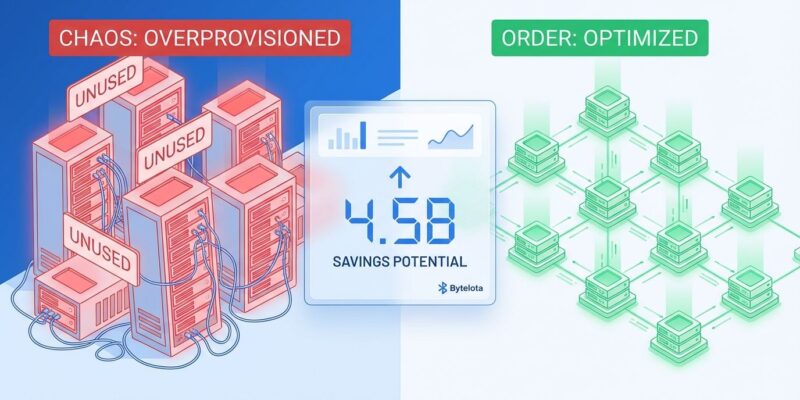
Organizations will waste $44.5 billion on cloud infrastructure in 2025—21% of all enterprise cloud spending—and the root cause isn’t technical. According to Harness’s FinOps in Focus report released this month, surveying 700 engineering leaders and developers, 52% cite the disconnect between FinOps teams and developers as the primary driver of waste. While tools for cost optimization exist, fewer than half of developers have access to real-time cost data, 55% admit their purchasing commitments are based on guesswork, and it takes an average of 31 days to identify and eliminate cloud waste. This is a people problem, not a technical one.
Developers Are Flying Blind—And They Know It
Fewer than half of developers have access to the cost data they need to make informed decisions. Only 43% can see real-time idle resource data, 39% have visibility into orphaned resources, and just 33% know when workloads are over or under-provisioned. The result: 55% admit cloud purchasing commitments are based on guesswork.
Here’s the twist: 62% of developers want more control and responsibility for managing cloud costs. The narrative that “developers don’t care” is wrong. They lack data, not motivation. Without visibility, developers overprovision “just to be safe” because they can’t quantify actual resource utilization. A service that needs 2GB of RAM gets 8GB. Multiply this across hundreds of microservices, and the safety margins compound into billions.
You can’t optimize what you can’t see. The visibility gap is the foundational problem—all other waste accumulates from this. When developers lack cost context at design time, they make conservative decisions that cascade into overprovisioning, idle resources, and forgotten test environments running 24/7.
By the Time You Find the Waste, You’ve Already Paid For It
It takes an average of 31 days to identify and eliminate cloud waste, and 25 days to detect and rightsize overprovisioned resources. That’s nearly a full monthly billing cycle before organizations even know resources are wasted.
Consider a common scenario: A developer spins up a test environment on Friday afternoon to debug an issue. They fix it and forget about it. That environment runs 24/7 for a month before anyone notices—generating thousands in unnecessary costs. By the time the bill arrives and finance investigates, another month of waste has accumulated. The feedback loop is broken.
In software engineering, we’ve learned that fast feedback prevents problems from compounding. CI/CD catches bugs before production. Real-time monitoring alerts teams to performance degradation immediately. Yet cloud cost management is stuck in 2010 with monthly billing cycles and slow detection. The 31-day detection problem isn’t a technical limitation—it’s an organizational choice.
The Tools Work—Organizations Don’t Use Them
Despite readily available cost optimization tools, organizations aren’t using them. 71% don’t use spot orchestration, 61% don’t rightsize instances, 58% don’t leverage reserved instances or savings plans, and 48% don’t track and shut down idle resources. Only 32% have fully automated cost-saving practices.
The FinOps Foundation’s 2025 framework outlines 22 capabilities across 4 domains for cloud cost management. Tools like Harness, CloudZero, and Vantage provide automated optimization, real-time dashboards, and cost visibility at the service level. The tools work. So why the adoption gap?
It’s not technical—it’s organizational. Teams lack training on cloud economics. Ownership is unclear: Is cost optimization the developer’s job? DevOps? Finance? Competing priorities win: Features ship, uptime targets are met, and velocity increases. Cost optimization gets deferred indefinitely.
This signals that cloud waste isn’t solvable with better software. It’s a cultural and organizational problem requiring clearer ownership, aligned incentives, and developer education. Throwing more tools at the problem doesn’t fix the structural issues.
Finance and Engineering Speak Different Languages
FinOps teams focus on budgets, forecasting, and cost control, operating on monthly or quarterly cycles. Development teams focus on features, performance, and reliability, operating on sprint cycles and feature delivery timelines. This structural misalignment creates blind spots on both sides.
FinOps teams recommend cutting “wasteful” resources without understanding technical requirements—breaking production systems and destroying credibility. Developers make architectural decisions without cost context—choosing the most convenient AWS region for a service without realizing cross-region data transfer fees will cost thousands monthly. Neither side has complete information.
The disconnect is structural, not accidental. Finance and engineering operate on different metrics (budget variance vs. feature velocity), timelines (quarters vs. sprints), and incentives (cost reduction vs. shipping features). This isn’t fixable with “better communication.” It requires process changes, shared tools, and new organizational models that bridge the gap.
What High-Performing Organizations Do Differently
High-performing organizations treat cloud cost management as a shared responsibility, embedding cost awareness into development workflows, providing real-time visibility to engineers, and investing in training. Organizations where engineering teams share responsibility for cloud costs are more likely to report spending under control.
Leading practices include real-time cost dashboards showing cost per service, per team, per environment. Tools like Harness and Densify embed cost visibility in CI/CD pipelines—developers see projected costs before deployment, not after the bill arrives. Showback reporting lets teams see their costs without being billed directly, building awareness without bureaucracy.
Developer training matters. Engineers understand RAM and CPU but not cloud pricing models. Training on reserved instances, spot instances, egress costs, and commitment discounts empowers better decisions. The FinOps Foundation’s working groups emphasize that professional pride drives cost-efficient solutions once engineers accept ownership and have the data to act.
Automated resource lifecycle management delivers quick wins. Tag resources by environment (production, staging, development) and auto-shutdown non-production after hours. Simple automation cuts dev/test costs by 60-70% without code changes.
The ROI is massive. For a $10M/year cloud bill, implementing comprehensive cost practices (automation, visibility, training) typically achieves 20-30% cost reductions—$2-3M in savings. FinOps tools cost $50-200K annually. That’s 10-60x ROI.
Key Takeaways
- $44.5 billion in cloud waste isn’t a technical failure—it’s an organizational one. 52% of engineering leaders cite FinOps/developer disconnect as the root cause, and the data bears it out: developers lack visibility, detection takes 31 days, and available tools go unused.
- Developers want cost responsibility but lack the data to act. 62% want more control, yet only 43% can see idle resources, and 55% admit purchasing decisions are guesswork. Fix the visibility gap, and motivation follows.
- Delayed feedback loops compound waste faster than organizations detect it. 31 days to identify waste means you’ve paid for a month before finding the problem. Real-time visibility and automation are the solution—monthly billing cycles are the enemy.
- The tools exist and work—adoption is the barrier. 71% don’t use spot orchestration, 61% don’t rightsize. This isn’t a technical problem requiring better software; it’s cultural, requiring training, ownership clarity, and incentive alignment.
- High-performing organizations embed cost as a first-class metric alongside performance and reliability. Real-time dashboards, CI/CD cost estimates, developer training, and shared responsibility models deliver 20-30% cost reductions. For $10M annual cloud spend, that’s $2-3M saved—10-60x ROI on FinOps investment.
The $44.5 billion question isn’t “What tool should we buy?” It’s “How do we bridge the gap between finance and engineering?” Start with visibility, empower developers with data and training, and treat cost optimization as everyone’s job—not just finance’s problem to solve.